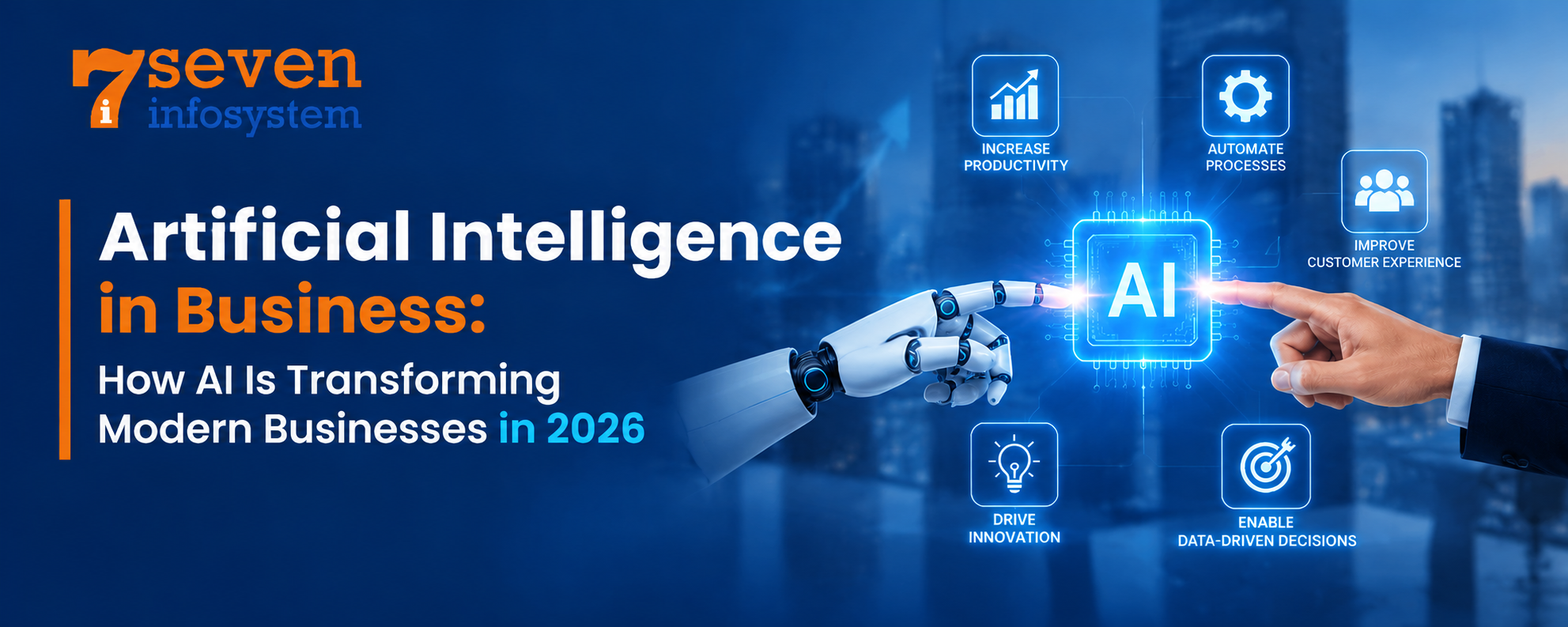
Artificial Intelligence in Business: How AI Is Transforming Modern Businesses in 2026
Discover how Artificial Intelligence in Business improves productivity, automates tasks, enhances customer experience, and drives growth in 2026.
Introduction
A year ago, a small bakery owner spent her Sunday evenings replying to customer messages, estimating how much flour to order for the week, and creating engaging social media posts. Today, Artificial Intelligence in Business helps her complete these tasks faster and more efficiently. For example, an AI assistant drafts customer replies, while an intelligent ordering tool analyzes monthly sales and weather forecasts to recommend the right quantity of ingredients. Additionally, AI-powered content tools help her create social media posts in just ten minutes instead of two hours. As a result, Artificial Intelligence in Business saves valuable time, improves daily operations, and allows small business owners to focus on growth. This simple example shows how Artificial Intelligence in Business is transforming everyday work in 2026. Moreover, businesses of all sizes can use AI to simplify routine tasks and improve productivity, giving owners more time to focus on what matters most.
The little story above tells you about a larger trend going on within the business community right now. While AI used to be just an exciting but useless lab development of a tech giant, now it resides in the applications we use on a regular basis – in emails, accounting software, customer support systems – and most of it does useful things
Obviously, along with all the excitement comes confusion. What tools are worth using? What jobs will be replaced by AI and what won't? Where do we even start?
Discover what Artificial Intelligence in Business really means in 2026, how to balance its benefits and risks, and how AI Development Services can help businesses of all sizes integrate AI effectively.
What Artificial Intelligence in Business Really Means in 2026
In its purest form, AI is software capable of learning from data, identifying patterns and making decisions that used to require human intelligence. From the perspective of businesses, it is all about solutions capable of analyzing documents, answering customer queries, predicting future demands, writing drafts and detecting issues.
From Buzzword to Everyday Tool
For a long time, artificial intelligence remained a topic of buzzwords rather than a practical solution. Implementation was costly and lengthy; projects would remain pilots. The situation has changed. Modern AI Business Solutions are ready-to-use solutions which are often integrated in the paid software you use regularly. Your sales platform starts scoring leads automatically. Your help desk starts suggesting answers. Your spreadsheet will interpret your data trends when asked in plain language.
Generative Artificial Intelligence, the kind that writes text, creates images and summarizes reports pushed this shift into high gear. Suddenly people, without any background could use Artificial Intelligence directly simply by typing a request.
The Role of AI in Modern Business
The Role of AI in Modern Business is perhaps best characterized by an able assistant who never tires out. It does not manage the firm, nor should it. Rather, what it does well is handle the dull, data-driven, and time-consuming activities of work leaving people to make decisions based on judgment and human relations.
The manager will decide which market to enter; however, the AI can compile the research within an afternoon rather than a month.
Key AI Applications in Business Across Departments
Another factor that explains the rapid adoption of AI is its wide applicability to any business field. Below you can find a list of AI Applications in Business and how departments make use of them in their daily work.
AI in Marketing and Sales
Teams from marketing and sales departments were among the first to adapt to AI due to obvious reasons. AI in Marketing and Sales allows teams to know who their customers are, what they need, and when they are ready to purchase.
Common uses include:
Lead scoring: assessing the probability of conversion and focusing the sales efforts accordingly.
Content creation assistance: helping to create email marketing campaigns, copywriting, product descriptions, and social media content that the person will then edit.
Product suggestions: making personalized recommendations based on the user's browsing and purchasing history just like any good e-commerce site does already.
Sales forecast: predicting the most probable deals to close and when to help the management have a clearer idea of their future income.
Headlines and images testing: comparing different options to determine which one performs best.
It is important to note that this technology does not aim to replace the human element of sales but to make sure sales people are more prepared to talk to customers.
AI for Customer Experience
Nowadays, customers expect instant and useful replies regardless of the time of day. The technology of Customer Experience AI allows this to happen even to those firms who cannot afford to work around the clock.
AI-powered chatbots can reply to the typical inquiries about order tracking, refund, and working hours. In case the question becomes too complicated, it is forwarded to a person along with the brief. In addition, AI can help in reading reviews and support tickets in order to find out what the main complaints are and solve them once and forever.
AI-Powered Data Analytics
Every company is storing too much data that they don't know how to use: sales figures, website traffic numbers, inventory data, customer reviews, etc. AI-Powered Data Analytics allows making use of all that data.
Rather than waiting for analysts to create reports, managers may ask questions like "What was the most popular product range in the south region during last quarter and what caused the increase in returns?" and receive an answer with graphical representation of the analysis done. AI will also be able to recognize strange patterns like a decrease in repeat purchases or a supplier that repeatedly delivers their orders late.
Operations, Finance, and HR
There are plenty of applications of AI outside customer-facing units:
Operations: Forecasting demand, planning delivery routes, managing stock levels, and predicting when machines need maintenance.
Finance: Reading invoices, matching payments, flagging suspicious transactions, and speeding up month-end closing.
HR: Resumes screening, answering employees' frequently asked questions about leave days, and training planning.
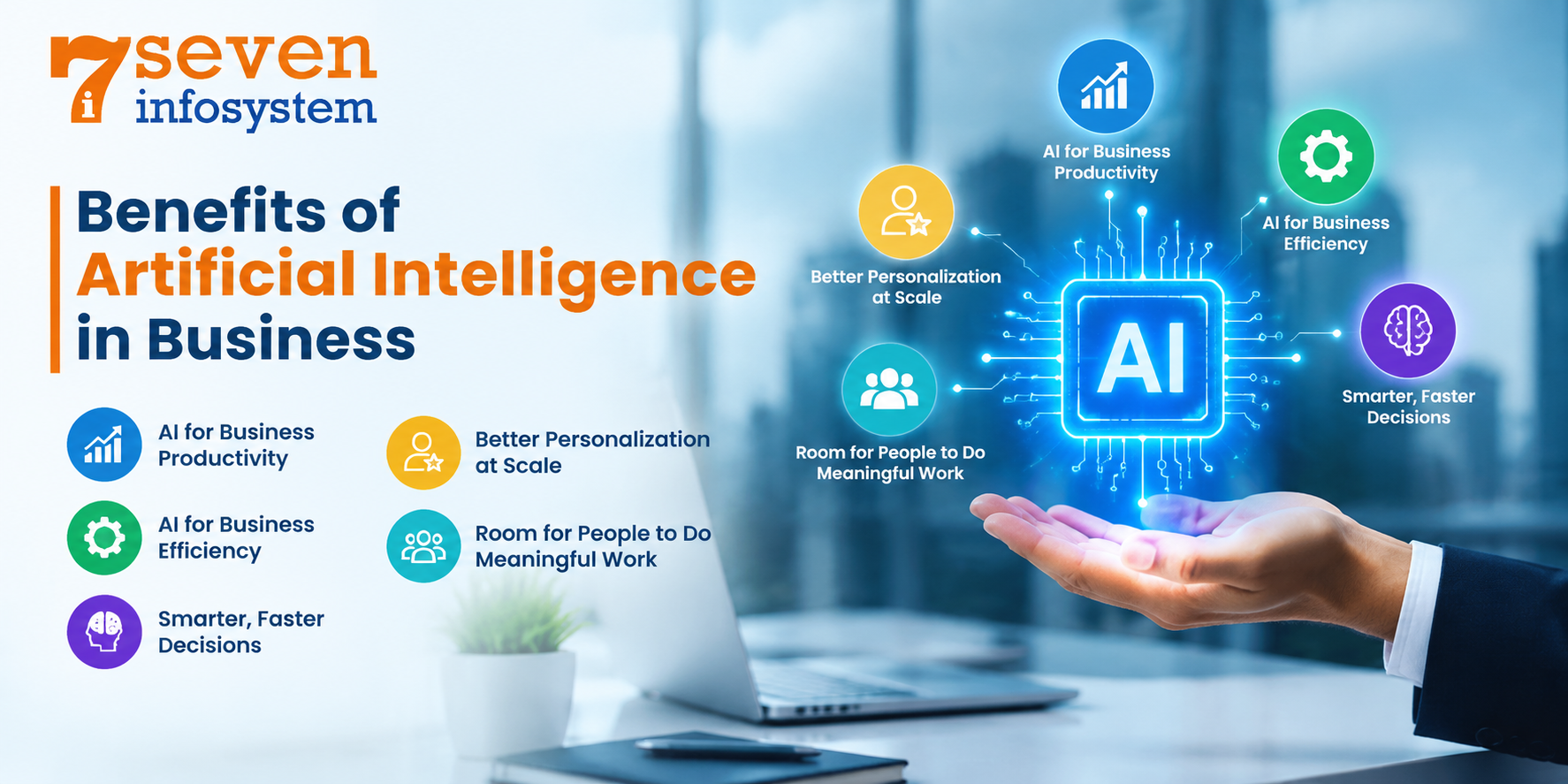
Benefits of Artificial Intelligence in Business
So then, what does the use of AI actually bring to businesses? The following are the major Benefits of Artificial Intelligence in Business.
AI for Business Productivity
First of all, the time spent on different tasks can be significantly reduced by AI for business productivity. Meetings can be recorded automatically, long e-mail chains are shortened by seconds, the first drafts are created before finishing your morning cup of coffee. Many teams find that work that used to take a full day now takes an hour, leaving more space for planning, problem-solving, and talking to customers.
AI for Business Efficiency
While productivity is the increase in output by an individual employee, efficiency is the optimization of the entire process in a business. AI for Business Efficiency leads to fewer errors in data input, faster approval and minimizes wastage such as excess stock orders and unnecessary long routes for delivery trucks.
Smarter, Faster Decisions
Smart decision-making requires smart information. Thanks to AI, leaders will get an accurate picture of the situation instead of making assumptions about what is happening. With clear forecasts and early warnings, businesses can react to changes in demand, pricing, or customer behaviour much faster than competitors relying on gut feeling alone.
Better Personalization at Scale
Treating everyone individually could be done only by smaller companies where the number of clients is rather small. Thanks to AI, such treatment of every person is possible when dealing with thousands of customers at once while keeping this individual approach.
Room for People to Do Meaningful Work
The least appreciated among all Benefits of Artificial Intelligence is what it does for the personnel. It frees them from tedious tasks leaving them time to do their jobs - form relationships, solve complicated problems, generate ideas.
Business Process Automation: Letting AI Handle the Routine
Any business will have some process that repeats itself: transfer of data from one system to another, scheduling reminders, approval of routine requests, generation of weekly reports. Business Process Automation turns these routine processes into software operations that work automatically and require no manual input.
How AI Changes Traditional Automation
Older automation could only follow rules. If this happens, do that. It had trouble with things, such as a scanned invoice that does not look normal or an email written in a casual tone. AI‑Powered Business Automation can handle that messiness. It can read documents, understand what the sender means and make judgment calls. Because of that many more processes can now be automated.
Practical Examples
Automated Business Solutions for Modern Businesses deal with:
Reading incoming invoices and entering the details into accounting software.
Sorting customer emails by topic and urgency, then routing them to the right person.
Creating weekly sales and inventory reports automatically.
Onboarding new workers through sending information, creating accounts, and organizing training.
Contacting the client after a purchase to request their opinion.
Before automating complex business processes, companies should define their requirements, plan the development stages, and establish testing procedures. Understanding the software development life cycle can help businesses approach these projects systematically.
AI Agents and the Human Check
A newer development in 2026 is the rise of AI agents, which can carry out -step tasks on their own such as researching a supplier, comparing quotes and preparing a summary for approval. They're powerful. They work best with clear limits. Let them prepare, sort and suggest while people approve anything involving money, contracts or sensitive customer decisions.
AI for Small Businesses: Big Results Without a Big Budget
The widespread misconception is that only large enterprises can leverage AI due to their huge budgets. However, it might just be the case that AI for Small Businesses is the place to see its most significant impact since small groups know how much time it is short on.
Affordable AI Tools for Businesses
Currently, a lot of AI Tools for Enterprises have become comparable in price to your monthly phone subscription and even incorporated into the software that small businesses are already using. Thus, a shopkeeper can leverage AI for writing product descriptions, a consultant can utilize it for preparing pitches, and a local services company can apply it for answering booking inquiries outside of business hours.
Popular AI-Powered Business Tools
Some of the useful AI Powered Business Tools for smaller teams include:
Writing assistants for emails, blog posts, and social media content.
Chatbots for websites and messaging apps that answer common questions.
Smart accounting software that categorizes expenses and tracks cash flow.
Scheduling tools that book appointments and send reminders automatically.
Graphic design systems that allow designing basic posters, presentations and other graphic content within a few minutes.
Small businesses can also consider SaaS applications to access cloud-based software, simplify maintenance, and scale their digital operations without managing all the underlying infrastructure.
Start Small and Grow
The best way to go for a small business would be to find one problem that takes up most of your time, solve it using an appropriate tool, and analyze the results. Then go for another one.
How to Approach AI Integration in Business
Buying a product is not a problem. The thing is to get real benefits from the tool. AI Integration in Business typically starts from a number of basic things.
Start With a Real Problem
Don't adopt AI just because everyone else is. Begin with a clear pain point, such as slow customer replies, messy data, or too much time spent on reports. A specific goal makes it much easier to choose the right tool and judge whether it's working.
Get Your Data in Order
AI relies on the data that you give to it. If, for instance, there are duplicates in your customer's database or sales numbers can be found in multiple Excel sheets, there won't be any meaningful outcome for you.
Involve Your Team Early
People who will be using AI daily know what the actual problems are. Solicit their advice on what AI tools will benefit them, how they'll help and provide training in a comprehensible way.
Run a Pilot, Then Scale
Try the tool with one team or one process for a few weeks. Keep track of results. Like how many hours you save, how much faster responses are or how many mistakes go down. If it helps expand it to teams or areas. If it doesn’t work, fix it. Pick a different tool. You don’t have to risk the company on one choice.
Mobile app development can help businesses build and test mobile applications with AI-powered features that improve user experience and streamline daily operations. Monitor the results by measuring time savings, customer satisfaction, response speed, and error rates. Gather feedback from employees and users, identify areas for improvement, and refine the application before expanding its features.
Set Clear Rules
Figure out who checks the work that AI creates. Decide what information the tools can use. Make sure some decisions always need a person to approve them. Simple rules, like these stop mistakes and help everyone feel safer using the tools.
Challenges and Risks to Keep in Mind
AI brings real advantages, but it's not without problems. Being honest about the risks helps you use it wisely.
Accuracy and Mistakes
AI can sound confident while being wrong. It may misread a document, invent a detail, or misunderstand a question. Anything important, especially facts shared with customers or numbers used in decisions, should be checked by a person.
Data Privacy and Security
AI may appear sure while AI is actually incorrect. AI can misread a document, create a detail or fail to understand a question. Anything important, especially facts that AI shares with customers or figures that AI uses for decisions, must be verified by a human.
Bias and Fairness
If the training data was biased, the AI algorithm will also make biased decisions. In such fields as recruitment, loan granting, or pricing, you have to pay particular attention to that problem.
The Future of Artificial Intelligence in Business
So where is all this heading? The Future of AI in Business looks like robots taking over and more like AI quietly becoming part of every tool and every role.
AI Will Feel Invisible
Looking towards the future, few will refer to themselves as "users of AI." This will simply be embedded within the software they use each day, just like spelling or online storage capabilities are today. Asking something of your data, summarizing a meeting, or crafting a proposal will become as second nature as it could get.
New Skills, New Roles
AI isn't merely taking over jobs; it is transforming existing roles and creating demand for new skills, such as asking effective questions, reviewing AI-generated output, and combining technology with human judgment. Businesses that invest in employee training alongside software development will be better positioned to use AI effectively and achieve long-term growth.
Trust as a Competitive Edge
As AI becomes common, customers will pay more attention to how businesses use it. Being open about AI use, protecting data carefully, and keeping a human available when it matters will set trusted brands apart.
Conclusion
Nowadays, AI is no longer considered a laboratory experiment but rather a part of regular corporate life. It assists the workforce in working quicker, making decisions, providing personalized service, and doing away with boring monotonous processes. All this has been made possible by cheap technology. However, to achieve success with AI in corporate life, one must use a structured approach.
The way forward starts with finding out what issue you want to resolve and choosing an appropriate tool for that. Then one needs to collect data, involve the team in the process and stay in control of the decision-making processes. This way, AI will turn into a very powerful assistant in your corporation.
What matters in the future success is not technology itself but the right approach to it. The successful corporations will be those which are able to use technology wisely.
FAQs
1. How is AI used in business today?
Businesses use AI for customer support, marketing, sales forecasting, data analysis, automating routine tasks, and improving everyday productivity.
2. Can small businesses afford AI tools?
Yes. Many AI tools are low-cost or built into existing software, making them practical even for very small teams.
3. Will AI replace employees?
AI mostly takes over repetitive tasks rather than whole jobs, freeing people to focus on creative, strategic, and customer-facing work.
4. What is the first step to adopting AI in a company?
Identify one specific problem that wastes time or money, then test a suitable tool on a small scale before expanding.
5. What are the main risks of using AI in business?
The biggest risks are inaccurate outputs, data privacy issues, and bias, which is why human review and clear rules are essential.