What Is the Software Development Life Cycle? A Complete Guide
Explore the Software Development Life Cycle, its key phases, models, and benefits to understand how teams plan, build, test, and maintain software.

Introduction
Every application, whether it’s an online banking platform or a food delivery website, starts as a simple idea on a whiteboard. However, turning that idea into reality requires more than skilled developers. Teams also need a clear strategy to align people, budgets, and timelines. This strategy is known as the Software Development Life Cycle (SDLC).
Without a clear plan, software projects can quickly become chaotic. For example, changing requirements, last-minute bugs, and rising costs can disrupt progress when teams lack a structured development process. Therefore, following a well-defined process helps everyone understand what to do, when to complete each task, and how to handle unexpected challenges. As a result, teams can manage projects more efficiently and deliver reliable software.
This guide explores the Software Development Life Cycle (SDLC), its key stages, popular models, and business benefits. Whether you are an entrepreneur planning your first software product or comparing options from a Custom Web Application Development Company, this guide will help you understand the software development process and make informed decisions for your project.
What Is the Software Development Life Cycle?
The Software Development Life Cycle (SDLC) provides a structured framework for managing a software project from the initial discussion to post-launch maintenance. It divides the project into several phases, each with specific goals and deliverables. As a result, teams can use this roadmap to plan, develop, test, and maintain software efficiently. Although the SDLC does not write code, it helps everyone involved track progress, coordinate tasks, and understand the next steps.
In essence, the software development process answers several important questions. What are we developing, and who will use it? How can we build the software efficiently? Furthermore, how will we test its functionality and verify that it meets user expectations? Finally, how can we maintain and improve the software after deployment? By answering these questions, teams can manage projects more effectively and deliver reliable software.
A Quick Look at Its Origins
The Software Development Life Cycle began to take shape in the 1960s, when large companies developed complex systems for banking, military, and government applications. These projects often involved high costs and significant risks. Therefore, engineers borrowed ideas from the manufacturing and construction industries to organize tasks, manage resources, and control the development process more effectively.
Over the years, software development practices continued to evolve. Initially, teams relied on strict methodologies that offered limited flexibility when requirements changed. However, developers gradually adopted Agile approaches and iterative development cycles to respond more quickly to changing needs. Today, many software teams combine traditional methods with modern practices to improve flexibility, manage risks, and deliver better results.
SDLC vs. Project Management
Although people often confuse them and consider the frameworks identical, they aren't really the same. Project management includes planning, budgeting, and human resources management throughout all kinds of projects, be it software development or construction of a building. Software development life cycle is only applied to software products. It concentrates on such aspects as requirements gathering, architectural design, coding, testing, and maintenance.
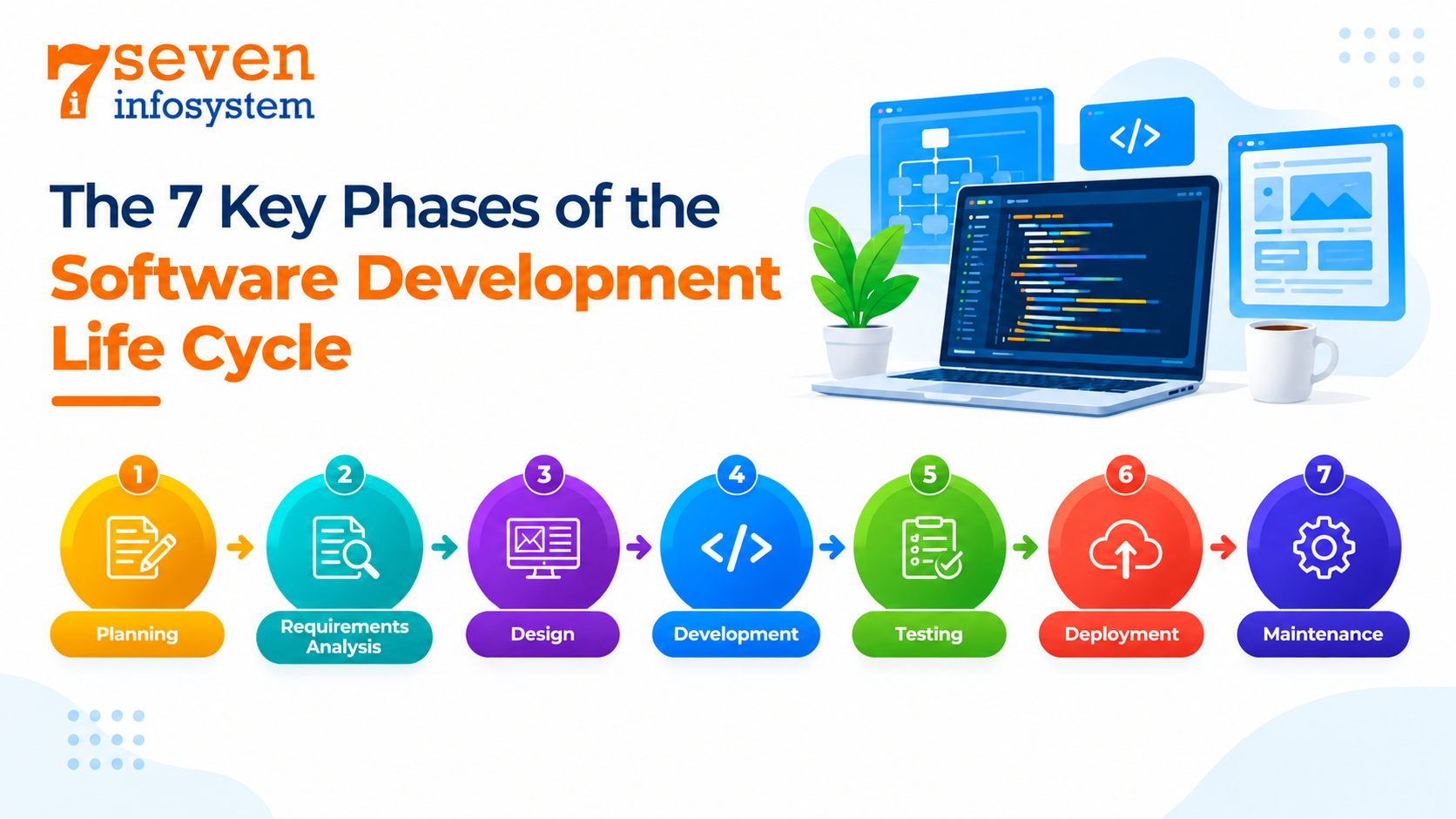
The 7 Key Phases of the Software Development Life Cycle
Typically, almost all the teams adopt a certain form of Seven Basic Software Development Life Cycle Phases. The names may slightly differ from one organization to another, while the Stages of Software Development remain almost the same. Let's see what takes place during each of them.
1. Planning
This is the first stage of software development, during which the team determines the purpose, scope, budget, and timeframe of the project. The representatives of business and technology analyze the feasibility of the idea. Is it worthwhile to implement the idea at all? Do we have enough resources and necessary skills? What challenges will stand in our way? Proper planning will definitely save you from unpleasant surprises in the future.
2. Requirements Analysis
At this stage, the team identifies the requirements for the project. The analysts consult with the representatives of stakeholders, end-users, and subject-matter experts in order to understand the two types of requirements. Functional requirements identify the features of software – for instance, allowing users to reset their passwords. Non-functional requirements include quality characteristics, such as performance, security, and scalability.
3. Design
With requirements in hand, architects and designers decide how the system will work. They plan the overall architecture, database structure, third-party integrations, user interface, and security approach. Proper design usually implies the creation of wireframes and clickable prototypes for the project to gather stakeholders' feedback without implementing even one feature yet.
4. Development
Now comes the development stage, wherein developers begin implementing designs through coding. Tasks are assigned and developed while reviewing each others' works and merging the code into one repository. Great teams develop according to a set standard in coding and version control in order not to overwrite one another's code. For web-based projects, this step is the core of all Web Development Services.
5. Testing
Before releasing software to users, the team thoroughly tests the product to ensure it works as expected. During this phase, testers evaluate its functionality, performance, security, and compatibility across different devices and environments. They also check whether the software meets the requirements established during the planning and analysis stages.
Teams use several testing methods to identify and fix potential issues. For example, unit testing checks individual components, while integration testing ensures that different modules work together correctly. Additionally, performance testing evaluates how the software handles heavy workloads, and security testing helps testers identify vulnerabilities that could expose sensitive data. Finally, user acceptance testing (UAT) allows users or clients to confirm that the product meets their needs and expectations.
6. Deployment
Deployment is the stage where the team releases the tested software into a live environment so users can access and use it. Before launching the product, developers prepare the production environment, configure servers, set up databases, and verify that all essential components work correctly. They may also migrate existing data and configure monitoring tools to track the software's performance after release.
Depending on the project's requirements, teams can choose different deployment strategies. For example, a full deployment makes the software available to all users at once, while a phased rollout introduces it gradually to selected groups. Similarly, a canary release allows a small group of users to try the new version before the team expands access.
7. Maintenance
Software development does not end when the product launches. Instead, teams maintain the software to keep it secure, stable, efficient, and relevant as user expectations and business needs evolve. After deployment, users may report bugs, operating systems may receive updates, and new security threats may arise. Therefore, developers continuously monitor the product and make improvements whenever necessary.
Software maintenance generally involves four key activities. Corrective maintenance fixes bugs and errors that appear after launch. Adaptive maintenance helps the software work with new operating systems, browsers, hardware, and external services. Meanwhile, perfective maintenance improves performance, usability, and existing features based on user feedback. Finally, preventive maintenance helps developers identify potential issues early and prevent future failures.
Together these Software Development Life Cycle Steps work more like a loop than a straight line. Feedback gathered during maintenance often flows back into planning for the next version.
Popular Software Development Life Cycle Models
Not all projects follow the sequence of the phases in the same way. Software Development Life Cycle Models organize the phases in different ways depending on the amount of flexibility, velocity or control required by the project. These models are alternatively referred to as SDLC Methodologies and the terms are basically interchangeable. The following models are some of those that will most likely interest you.
Waterfall Model
The Waterfall Model in Software Development is the way. Each phase is completed before the one starts like water flowing down a set of steps. It works well when the requirements are clear and unlikely to change, such as fixed‑scope contracts or projects, in regulated industries. The downside is that late changes can be slow and expensive because the team must go up the steps.
Agile Model
In the Agile method, the development process is divided into brief cycles known as sprints, which take one to four weeks. After the completion of each sprint, a useful piece of the product is delivered, and feedback is collected. Therefore, the Agile method is very suitable for developing software products that have constantly changing requirements, such as SaaS applications and mobile applications. The Scrum and Kanban are common implementations of the Agile methodology.
Iterative Model
than building everything at once the iterative model begins with a basic version and enhances it through multiple cycles. Each cycle adds features and refinement. This allows a working product to reach users quickly although it requires planning to avoid the scope growing too large.
Spiral Model
Spiral model blends the benefits of iterative software development with a significant concern regarding risks. The process involves planning, risk analysis, construction, and evaluation phases. Spiral model is appropriate for large and costly software projects where failure would cost dearly, though it may appear excessive for simpler projects.
V-Model
Also known as verification and validation model, V-Model links development activities with testing activities. System design, for instance, is linked with system testing. It adds discipline to quality assurance processes and is popular in such industries as medicine and automotive industry.
DevOps
DevOps refers to practices rather than to a specific software development model. This practice brings development and IT operations together and makes use of automation, continuous integration and continuous delivery practices. Development, release and monitoring occur almost continuously.
Software Development Life Cycle Examples in Real Projects
Once we observe examples of models in practice, they become quite easy to understand. Some of the Software Development Life Cycle Examples are:
The record system of the hospital can go by the name of V-Model since all features have to meet compliance standards.
The start-up with an e-commerce site will probably use Agile because it involves releasing features every two weeks depending on customer behavior.
The governmental payroll system with defined requirements can stick to Waterfall throughout the entire project.
The video streaming service will probably rely on DevOps because it will allow making several releases a day without any downtime.
There is no universal model that is best for everyone. Each model suits different goals, budgets, timeframes, and changeability.
Why the SDLC Matters for Your Business
The Importance of Software Development Life Cycle lies in one key point – predictability. With everyone working according to the same road map, a lot less surprises occur. Managers can estimate their budget more accurately while developers know exactly what should be done.
Key Benefits of SDLC
The Benefits of SDLC show up across the whole project, not just in one corner of it:
Clear understanding. Everyone knows what is being developed, how quickly and how costly this process would take.
Greater quality. The testing stage appears from the very beginning rather than at the end of the process.
Low expenses. It is cheaper to notice any problems at an early stage.
Smoother communication. Stakeholders, designers, developers, and testers share a common language and set of milestones.
Improved risk management. All possible problems are detected and fixed before they become critical.
Simple updates. Proper documentation allows updating the project easily no matter who is doing it.
The Role of Software Testing and Maintenance
Although businesses sometimes overlook software testing and maintenance or allocate insufficient budgets to them, both activities play a crucial role in a product’s long-term success.
Software testing protects your brand reputation by helping teams identify problems before they reach customers. For example, a failed payment, a software crash, or a data breach can damage customer trust within days. To prevent these issues, development teams use automated testing, peer code reviews, and security audits. These practices help teams detect bugs early, strengthen security, and deliver a reliable user experience.
Software maintenance also protects your investment in development by keeping the product useful and efficient over time. Teams fix bugs, install security updates, upgrade software libraries, improve performance, and add new features based on customer feedback. Furthermore, regular maintenance helps businesses adapt to changing technologies and user expectations. By investing in testing and maintenance, businesses can reduce future repair costs, improve customer satisfaction, and extend the software’s lifespan.
Software Development Best Practices to Follow
Following the phases is a great start, but how you carry them out matters just as much. These Software Development Best Practices help teams get better results with fewer headaches:
Work with real users. Interviews and prototyping uncover issues that internal teams often overlook.
Express requirements clearly. If there is an ambiguity in the requirement, somebody will implement it wrong.
Maintain version history of all materials. Not only code but also configuration and documentation needs to have a version history.
Automate testing and deployment. Automation removes repetitive manual steps and cuts down on human error.
Peer review the source code. A second opinion will detect possible bugs and distribute the information throughout the team.
Documentation goes while doing. The notes taken while doing something give better results than those taken after several months.
Build security from the start. Fixing security flaws after launch is costly and risky.
Collect information, learn and change. Measure such metrics as release frequency and number of bugs and apply this knowledge to the next iteration.
How to Choose the Right Development Partner
There are quite a number of companies that lack staff to manage all stages of the software life cycle. In such a situation, professionals of Software Development Services come to rescue. Professional partnership provides qualified specialists, tried-and-tested processes and software tools that will take a lot of years to develop.
When evaluating a Custom Web Application Development Company, it is important to consider not only the cost but also how they manage the process of developing. Here are a few questions that are worth asking about the process:
What development models do they use and how do they choose among them?
What are the ways of requirement gathering and documenting?
How do they conduct the testing process?
Is there any post-release support?
Can they give some references from their projects in a similar area?
Ready-made solutions are perfectly suitable for ordinary tasks. However, in case your workflows are specific and the product should give you competitive advantage, Custom Web Development Services may be more beneficial for you in the long run.
Conclusion
The Software Development Life Cycle (SDLC) brings structure and clarity to the software development process. It guides teams through seven key stages: planning, requirements analysis, design, development, testing, deployment, and maintenance. By following these stages, teams can turn ideas into functional software products while managing resources, reducing risks, and maintaining quality.
Choosing the right development model also plays an important role in project success. For example, the Waterfall model works well when requirements remain stable, while Agile supports projects that need frequent changes and improvements. DevOps practices also help teams streamline development, testing, and software delivery. Therefore, evaluate your project's goals, budget, timeline, and flexibility requirements before selecting an approach.
In addition, follow software development best practices, conduct thorough testing, and maintain your product regularly to achieve better results. If you are planning a new software project, start by mapping your requirements to the appropriate SDLC stages. This approach helps you identify gaps early, avoid costly mistakes, and keep your project on track.
FAQs
1. What is the software development process?
The software development process is a structured approach to building and maintaining software. It guides teams from initial planning and requirement gathering to coding, testing, deployment, and ongoing improvements.
2. What are the seven main phases of software development?
The seven main phases include planning, requirements analysis, design, development, testing, deployment, and maintenance. Each phase helps teams complete specific tasks and move the project toward successful delivery.
3. Why is a structured development process important?
A structured process helps teams manage budgets, meet deadlines, reduce risks, and improve software quality. Additionally, it promotes better communication among developers, testers, project managers, and stakeholders.
4. What are the popular software development models?
Popular models include Waterfall, Agile, Iterative, Spiral, and V-Model. DevOps practices also support continuous integration, delivery, and monitoring. Each approach offers different advantages depending on project requirements and complexity.
5. How do I choose the right software development model?
Choose a model based on your project scope, budget, timeline, and flexibility requirements. For example, Agile works well when requirements change frequently, whereas Waterfall suits projects with clearly defined and stable requirements.