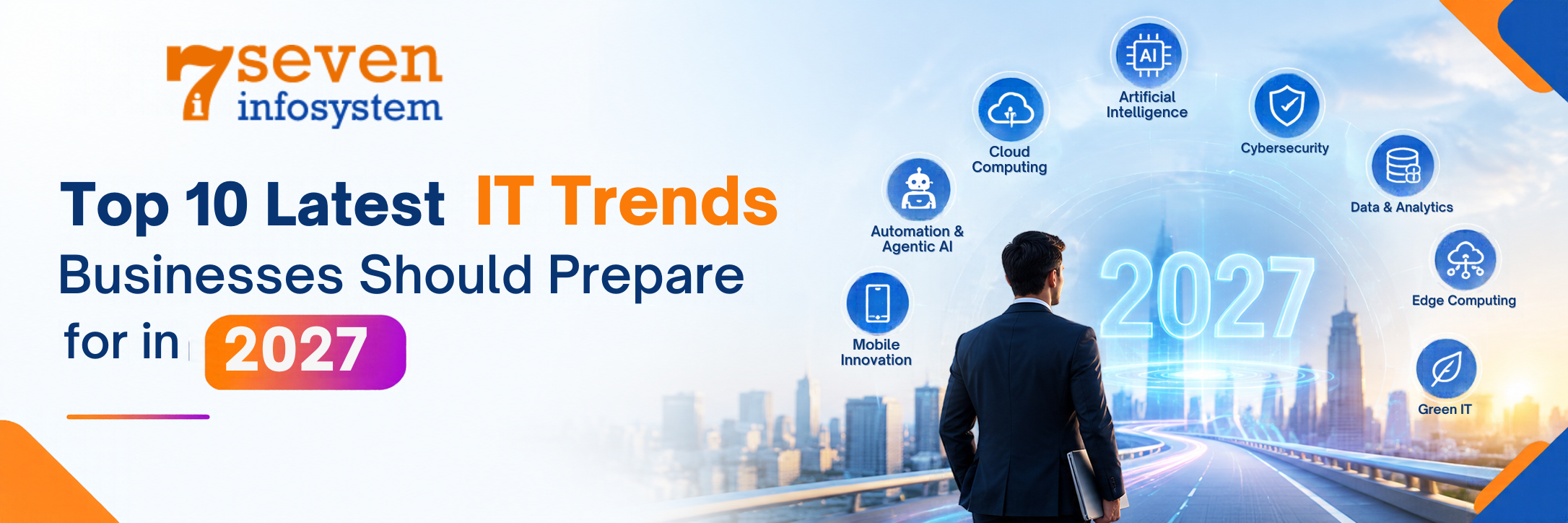
Top 10 Latest IT Trends Businesses Should Prepare for in 2027
Discover the latest IT trends in 2027, from AI and automation to cybersecurity and cloud computing, helping businesses prepare for the future.
Introduction
Every year brings new innovations, technologies, and expectations for businesses. However, the latest IT Trends in 2027 promise much more than just new technological developments. Over the past few years, many technologies remained in the testing and pilot stages. Now, businesses are actively implementing them in daily operations, creating a wider gap between companies that adopt innovation and those that fall behind.
For business owners and IT leaders, the biggest challenge is not finding information about IT trends. Instead, it is identifying which technologies truly matter, which innovations can wait, and where to invest the technology budget first.
This guide provides a detailed overview of the Top 10 IT Trends that will shape how businesses operate, compete, and protect themselves in 2027. For example, AI Development Services can help companies improve efficiency, automate repetitive tasks, and remain competitive in an evolving digital landscape. Moreover, you will discover practical business applications, real opportunities, and actionable recommendations without unnecessary marketing language.
Whether you run a small business or manage technology for a large enterprise, these Latest IT Trends will influence your business in one way or another. Therefore, understanding these developments today can help you make smarter technology decisions and prepare your business for the future.
Why the Latest IT Trends Matter for Businesses in 2027
The role of technology in organizations was always limited. Now it influences any organizational process, including pricing strategy and customer support at 2 a.m.
Several changes make next year particularly relevant:
Maturity: The Emerging Technology Trends of previous years became mature enough to be relied on by businesses for running their core processes. AI solutions, cloud platforms and IoT devices are already there.
Customer expectations: People expect instant and personalized customer service across all available channels. It is getting increasingly hard to meet those expectations using old-school technologies.
Competitive pressure: When your competitors reduce prices or accelerate their delivery using new technology, you become less competitive by just doing nothing.
Risk: The more digital the business you are running, the more damage you will suffer from any breach, outage or data loss.
Learning about wider Business Technology Trends enables managers to avoid two common pitfalls – chasing every new tool available or resisting change until it is forced upon you. The right approach lies somewhere in between: learn about new opportunities, experiment with them and implement what worked.
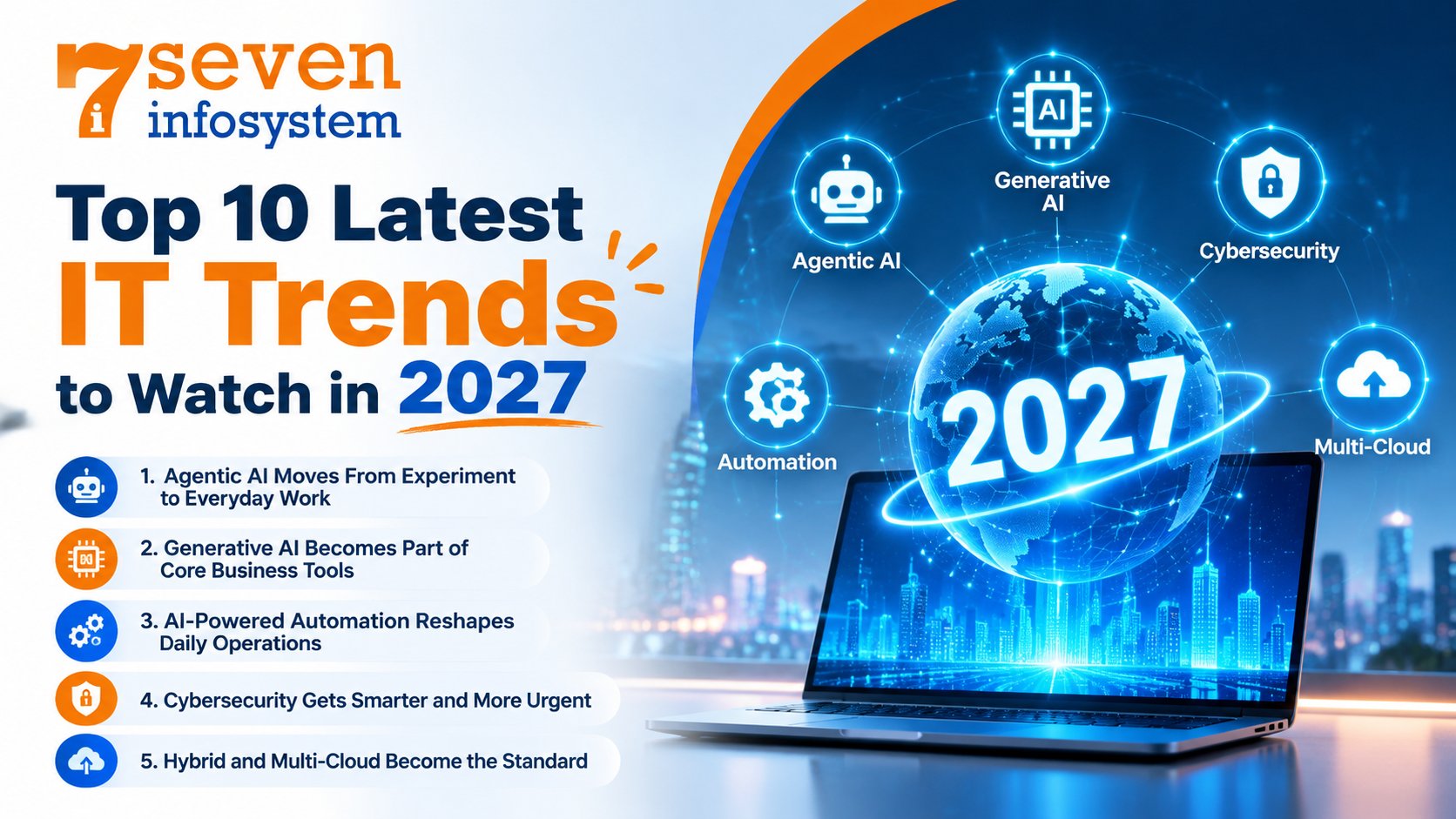
Top 10 Latest IT Trends to Watch in 2027
Below are the top ten trends that are most likely to define the budget, team structure, and customer experience within the next year.
1. Agentic AI Moves From Experiment to Everyday Work
Whereas the past two years have been associated with chatbots capable of answering simple queries, 2027 is the time of true AI capable of carrying out tasks. Agentic AI is a system able to plan an activity, perform multiple steps, use multiple software tools and track its own performance with minimal human intervention.
It is sufficient to imagine an AI agent that processes a refund request, reviews the order history, verifies the return policy, provides a refund, and updates CRM. Unusual cases are automatically reported for review by a human. Multi-step processes are what agentic AI is designed to perform.
Out of all Artificial Intelligence Trends listed below, this one is likely to affect teams most. It makes sense to begin with well-defined low-risk workflows, limit capabilities of AI agents, and involve humans in important decisions.
2. Generative AI Becomes Part of Core Business Tools
Generative AI technology is no longer confined to creating emails and images. By 2027, it has become a part of the software that people already work with on a daily basis: office suites, design software, programming platforms, help desks and dashboards for analysis.
What matters now is the ability to customize. Companies are now integrating AI not only by means of universal models, but also linking AI to their own documents, products and internal knowledge, thus getting more relevant responses.
Useful tasks include writing proposals, creating summaries, writing descriptions of the products, reviewing codes and producing drafts of training materials. Companies that will make the most of it will be those using it with proper quality controls, strict privacy policies and realistic expectations.
3. AI-Powered Automation Reshapes Daily Operations
Traditional automation followed fixed rules: if this happens, do that. AI-Powered Automation adds judgment. It can read messy documents, understand context and adjust when something doesn't match the usual pattern.
This gives you the possibility to automate tasks which previously could only be done by people such as the processing of invoices in multiple formats, prioritizing support tickets, matching applicants to vacancies or matching entries in accounting.
For most organizations, this is when the benefits of Artificial Intelligence in Business become more evident: less manual intervention, increased efficiency and decreased errors. Begin with identifying the repetitive tasks and how much time they currently take, and automate those with the greatest ROI.
4. Cybersecurity Gets Smarter and More Urgent
Each addition of an AI software, cloud solution or device opens up one more way for hackers to get in. And hackers are already using AI, creating more sophisticated phishing messages, audio scams and automated cyberattacks.
These are some of the most significant Cybersecurity Trends 2027:
Zero trust security, which means no one gets trusted from the start, even inside your own corporate network
AI-driven threat detection technologies detecting anomalous behavior
Stronger identity protection, measures like password-free logins and phishing-proof multi-factor authentication
Securing AI systems themselves, protecting the training data used by AI models and the permissions set for AI-powered software
Early planning for post-quantum encryption quantum encryption as quantum computing slowly advances.
Cybersecurity is no longer the IT team’s job. Regular staff training, a clear incident response plan and tested backups matter as much as any tool you buy.
5. Hybrid and Multi-Cloud Become the Standard
The debate about the cloud has gone beyond the question of "should we move?" Most companies already operate under a hybrid model with different parts of the workload running in either the public or private clouds or even across multiple cloud providers.
The Key Cloud Computing Trends for 2027 are:
Tighter cost control (FinOps) as the bills get bigger because of the high computational requirements of AI workload
Industry-specific cloud platforms such as healthcare, financials, manufacturing, and retail
Data sovereignty, with an increased number of organizations choosing where their data will be located based on specific regulations
AI-ready infrastructure, with a possibility of accessing GPUs and dedicated hardware
The idea is not chaos but flexibility. A proper cloud strategy, good governance, and frequent cost assessments will help avoid unnecessary spending on idle resources.
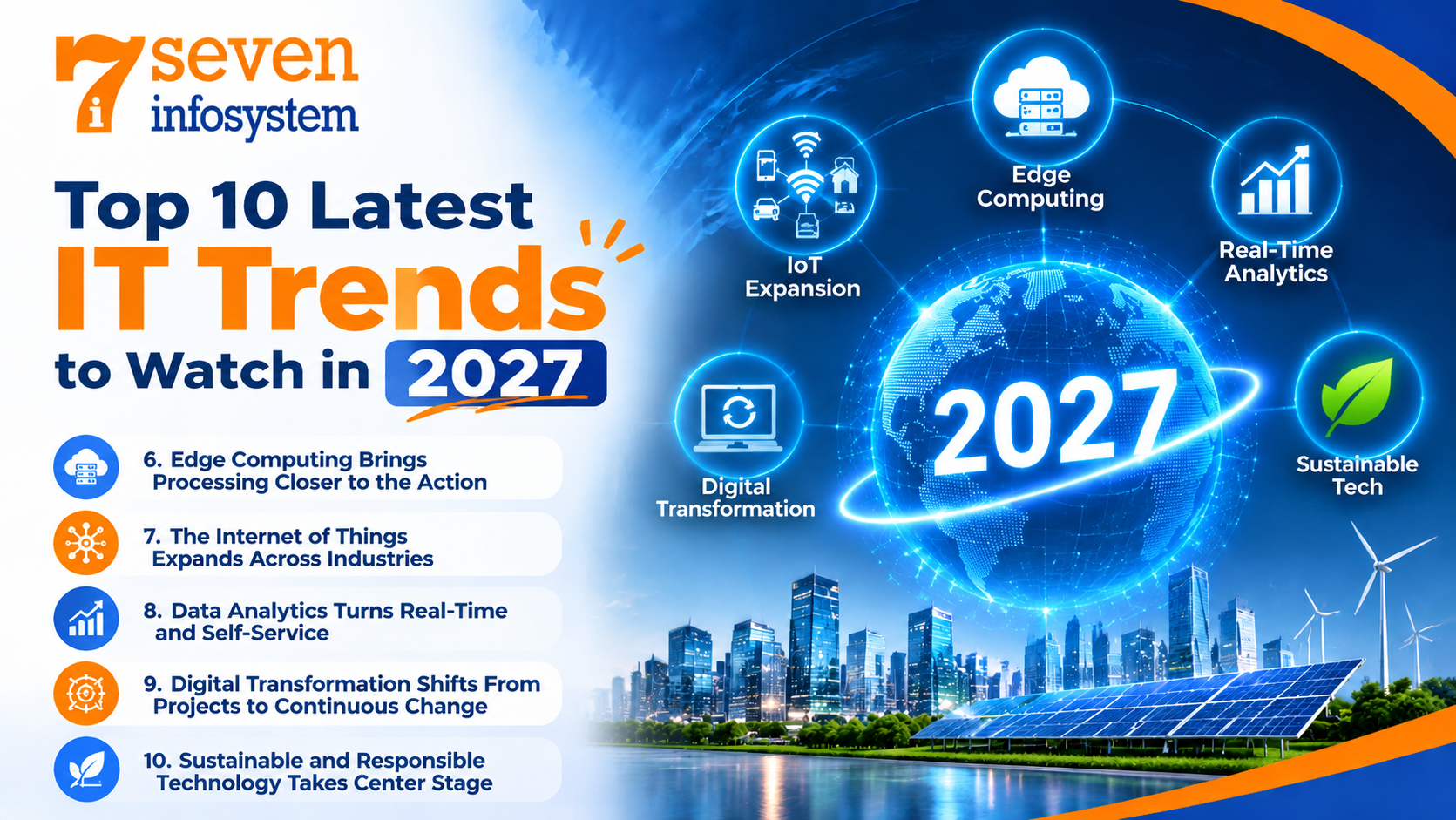
6. Edge Computing Brings Processing Closer to the Action
Not everything has to be sent to the data center to get processed. In Edge Computing, computations happen in proximity to the source location, such as the manufacturing facility floor, the sales department of the retail chain, hospital, and even a delivery truck.
The advantages are shorter latency, reduced bandwidth expenses, and increased reliability in case of network failures. This applies to activities such as manufacturing line quality control, real-time stock management, and security monitoring, during which even small delays can bring negative consequences.
In 2027, there is an increased integration between the edge and AI technology. With the development of smaller and more efficient models of AI systems, it is possible to perform computations locally, to make decisions and to send the results to the cloud. Organizations with physical business locations should consider opportunities for faster local decision-making.
7. The Internet of Things Expands Across Industries
The Internet of Things (IoT) refers to the interconnectivity between various physical objects, such as sensors, devices, cars, and other equipment, through the internet. While this technology is not entirely new, IoT is becoming increasingly valuable due to the decreasing cost of sensors, improved analytics technologies, and the growing demand for Mobile App Development to monitor and control connected devices in real time.
Popular uses of the technology include:
Predictive maintenance, where devices alert about any issues to avoid machine failures
Smart buildings optimize their energy consumption
Fleet and asset tracking for logistics and field service teams
Cold-chain monitoring for food and pharmaceutical products
Security still represents the most significant challenge because each device that is connected to the internet presents another entry point. Hence, a company needs to have an up-to-date inventory of devices, update firmware regularly, and use a separate network for IoT technologies.
8. Data Analytics Turns Real-Time and Self-Service
Data does nothing unless it is put to work. And Data Analytics Trends for 2027 put all their emphasis on speed and convenience.
With real-time analytics, companies get the opportunity to act right in the process, instead of waiting for the monthly report. Natural language interfaces help employees ask questions like “What products saw a reduction in sales in the northern region during the last quarter?” without having to write any code.
On the backend, Machine Learning technology makes forecasts, detects frauds, analyzes demand, and predicts customer churn. But none of it would be possible without data. Good and properly managed data lies at the bottom of every AI project.
9. Digital Transformation Shifts From Projects to Continuous Change
For a long time, businesses treated digital transformation as a one-time project with a fixed start and finish. However, this approach no longer meets modern business needs. Today's Digital Transformation Trends focus on continuous improvement, ongoing skill development, and adapting to new technologies rather than completing a single project.
For example, businesses can gradually replace outdated legacy systems, adopt low-code and no-code platforms, and connect different applications to improve communication across departments. As a result, employees can build simple applications, share information more efficiently, and complete daily tasks faster.
Moreover, successful digital transformation requires a strong focus on people. Even the best technology cannot deliver results if employees lack the skills or confidence to use it. Therefore, successful organizations train their teams, involve employees in technology decisions from the beginning, and measure improvements through business results. These results may include faster service delivery, lower operating costs, improved productivity, and better customer experiences rather than simply counting the number of installed software tools.
10. Sustainable and Responsible Technology Takes Center Stage
Artificial Intelligence and cloud computing consume significant amounts of energy. As a result, customers, investors, and regulators increasingly focus on environmental impact. In 2027, Sustainable and Responsible Technology will play a major role in business strategies, while Green IT will become a genuine business priority rather than just a marketing slogan.
Businesses are now choosing energy-efficient hardware, partnering with cloud providers that use renewable energy, extending device lifespans, and tracking the carbon footprint of their IT operations. Moreover, these practices help companies reduce energy consumption, control operating costs, and support environmental goals.
Responsible technology also includes how businesses develop and use AI. For example, companies must establish clear policies that promote fairness, transparency, data privacy, and accountability. Furthermore, governments across various countries are introducing regulations that encourage organizations to use AI responsibly and protect user data.
How to Prepare Your Business for the Latest IT Trends
Knowing what's coming is useful. Acting on it sensibly is what makes the difference. Here's a practical roadmap any business can follow, whatever its size.
Review where you stand today. List your current systems, tools, data sources and biggest pain points. You can't plan a route without knowing your starting point.
Tie technology to business goals. Make a list of your systems, the tools you use, the data you collect and the biggest problems you face. You cannot plan a journey if you don’t know where you are starting from.
Start small and measure results. Run a pilot project focused on one area. Set goals for success. Only expand the project if it shows results.
Get your data in order. Almost all trends on this list require access to clean data. Data quality pays off twice.
Build security into every decision. Assess the cybersecurity implications of each innovation beforehand.
Invest in your people. Help your team build skills in AI, cloud and data. Even the best tools deliver little without people who know how to use them.
Choose partners carefully. A professional IT partner will guide you through the process efficiently.
The future of technology for businesses will favor companies that stay curious and practical. Be open to ideas but careful, about what you actually adopt. Stay smart, stay focused and stay ahead.
Conclusion
What is going to define the upcoming year? There are going to be multiple technologies reaching maturity simultaneously and beginning to operate cohesively. Artificial intelligence algorithms will rely on pristine data, edge devices will provide cloud computing platforms with information, and each and every connection will require solid security.
The companies that succeed in this year will not be the largest spenders. Those who will know which IT trends correspond to their objectives, will act timely on them and involve employees in the process.
The Future of Information Technology is not about having access to the latest tools. Rather, it is about the use of those which can be used effectively. Choose one or two topics from the above and start a small-scale project this quarter. This way, you will be in much better shape in 2027.
FAQs
1. What are the latest IT trends for 2027?
The main ones are agentic AI, generative AI, AI-driven automation, stronger cybersecurity, hybrid cloud, edge computing, IoT, real-time analytics, ongoing digital transformation and sustainable tech.
2. What is agentic AI in simple terms?
It's AI that can plan and finish multi-step tasks on its own using different software tools, while people oversee important decisions.
3. Can small businesses benefit from these trends?
Yes. Many cloud services and AI tools are affordable subscriptions, so small teams can automate routine work without large upfront costs.
4. Why is cybersecurity such a big priority in 2027?
Attackers now use AI to create more convincing scams and faster attacks, so stronger identity protection and staff training are essential.
5. Which IT trend should a business focus on first?
Start with the trend that solves your most pressing problem. For many companies, that means automation or improving data quality.