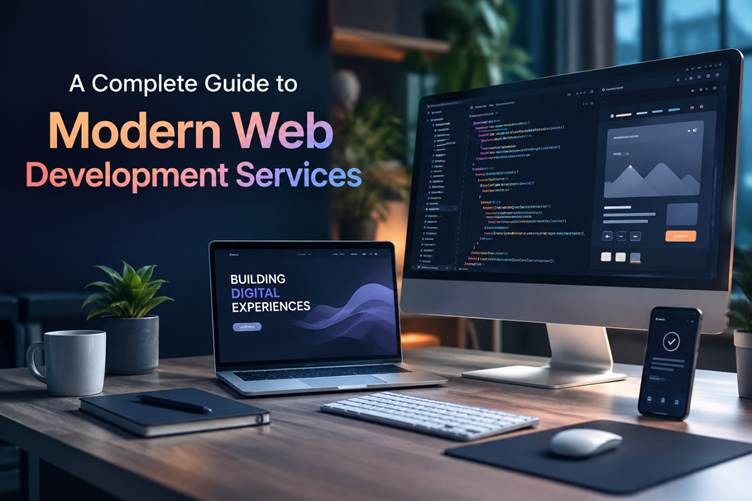
A Complete Guide to Modern Web Development Services
Explore modern web development services, including custom web applications, responsive websites, eCommerce, APIs, security, testing, and ongoing maintenance.
The internet has changed how businesses talk to customers, sell things, offer services, and make their brands known. A professional website is not just a website with information about the business. Nowadays, it can be a place where people can buy things, get help, book things, and learn about the business. It is also a tool for marketing and a central place for the business to operate.
This change has made web development something that businesses need to grow. Businesses can use the internet to make websites that work well on phones and computers. They can even make their own online stores and special programs. This helps businesses make websites that are fast, easy to use, safe, and fun to use.
Making a website is not just about writing code. It is about planning, making sure the website is easy to use, designing the website, writing the code, managing the data, keeping the website safe, making sure it works well, testing it, and keeping it updated. If businesses understand all these things, they can choose the way to make their website and make a website that really works for them.
What Are Modern Web Development Services?
Modern app development services include the planning, design, development, testing, deployment, and maintenance of websites and web-based applications.
Traditional websites were usually made to show information. Modern websites are more interactive and connected. They can talk to databases, handle payments, work with platforms, change content, do business tasks automatically for each user, and give people app-like experiences right in a browser.
A modern web development project can have frontend development, backend programming, API integration, database work, cloud setup, security measures, speed improvements, and ongoing support.
The specific mix depends on the business goal, the people the business wants to reach, the industry, and how complicated the project is.
Why Businesses Need Modern Websites
A website is usually the thing a potential customer sees when they look at a business online. If the website is slow, hard to navigate, does not work well on phones, or looks old, it can give a bad impression before the visitor even knows what the business is about.
These days, people who make websites try to create websites that are useful and look good.
A website can help businesses do a lot of things such as:
Establish a presence online
Reach customers whether they are using a computer or a mobile phone
- Get people to contact them
- Sell things online
- Do tasks so they do not have to be done by hand
- Make customers happier
- Connect different computer systems
- Help with marketing
- Collect useful information for the business
- Make the business seem trustworthy
Having a website is not the main goal. The main goal is to build a website that helps the business do better. A website should be something that helps the business, not something that exists. Businesses need a website that’s a valuable tool, like a digital asset that contributes to how well the business does.
The Core Layers of Modern Web Development
Modern web development is made up of parts that are connected. Each part has its job, but they all work together to make a full web experience. The way web development works today is built on these parts. Every part plays a role in making sure the web works the way it should. The way web development works today is built on these parts. Each part helps in making sure the web works the way it should.
Frontend Development: Building the User Experience
Frontend development is about the things that users see and use on their computer or phone when they are looking at a website.
The website is made up of lots of parts, like the layout of the page, the menus that you use to navigate, the buttons you click, the forms you fill out, the animations that move around, the pictures, the way the words look, the dashboards, the product pages, and all the other things that you can interact with on the website.
When it comes to building the website, people usually use things like HTML, CSS, and JavaScript, and other tools like React, Next.js, Angular, and Vue to build the website.
The main goal of frontend development is to make sure that the frontend of the website works on all types of devices, such as computers and phones, so the website looks good and works well on all of them, and this is what frontend development is all about: making the website work properly on all devices. Frontend development should be easy for everyone to use. It should make sense. It should be simple to figure out. Also, frontend development should load quickly on all screen sizes.
The main idea of frontend development is to make it easy for users to find what they are looking for and do what they want to do without getting frustrated or stuck with the frontend development.
Backend Development: Powering Website Functionality
The backend works behind the part of the app that people see. It takes care of the rules for how the app works. It decides who is allowed to use it. It handles where information is stored. It controls what happens on the server. This thing helps different parts work together. It figures out who can do what and what they are allowed to do. It is about how the data is handled. Some common tools that people use to build the backend are Node.js, Python, PHP, Java, and.NET.
For example, when a person signs up for an account, buys something, reserves a spot, or fills out a form, the backend takes that data from the person. The backend is what handles all of this data from the person. The backend sends it to the place where it is stored or used by other services. A strong backend needs to be built with safety in mind. A strong backend needs to be able to grow as needed. A strong backend needs to be easy to fix or update. A strong backend needs to be fast in how it works.
Database Development and Management
Web applications often need to keep and retrieve information. Databases are the basis for managing this information.
When people are working on a project, they have to figure out what kind of database they want to use for the project.
To create a database for the project, people have to do things like plan what the database will look like and what it will be used for in the project.
- Data modelling
- Database architecture
- Query optimization
- Data relationships
- Strategies
- Access control
- Performance management
If a database is set up correctly, it helps web applications function well and makes it easier to implement changes later on. A well-designed database is very important for web applications like these. It helps these web applications run smoothly and simplifies their development in the future.
Responsive Web Development for Every Screen
People use the internet on all kinds of devices, such as smartphones, tablets, laptops, and desktops. If a website is only built for one of these, it can be very frustrating for people who are using another.
The thing that helps with this is called web development. It makes the website change to fit the screen it’s on.
This means the website can have features, like grids that get bigger or smaller, pictures that change size, and words that are easy to read. The website can have buttons. Features that are easy to use on a phone. This is important because it makes the website easy to use when you are on your phone.
Creating websites that work well on a phone is very important. People often look for businesses on their phones when they are searching or watching videos. If a website works well on a phone, people are more likely to stay on the website and look around the website. This is why websites that work well on a phone are so important for businesses and their websites. A website that works well on phones can make people happier and less likely to leave the site.
Custom Web Application Development
Not every business can use a website template.
Some businesses need something unique because they conduct business in their own way. Companies with distinct methods may require custom web applications designed specifically for them.
For example, this can include things like customer portals, booking platforms, inventory systems, employee dashboards, CRM solutions, learning platforms, property management systems, and business management applications. When you create something custom, you can make it do exactly what you need it to do rather than changing your business to fit someone else’s system. Custom web applications allow you to make something that works the way your business really works.
A custom application can also work with things you already use, like web app development, APIs, payment gateways, communication platforms, analytics tools, and other business systems. This means custom web applications can be a part of your business, not just a separate thing.
eCommerce Website Development
Online shopping has created a need for websites that make it simple to buy things. ECommerce development can include things like product lists, ways to search and sort products, shopping carts, user accounts, checkout processes, payment options, managing orders, offering discounts, tracking stock, and linking with shipping services.
An online store needs more than technical features. How products are displayed, how quickly pages load, how easy it is to use on phones, how simple the checkout is, signs that create trust, and how well the store talks to customers all influence how people feel when they shop.
A modern e-commerce platform should therefore bring together technology with designs that focus on the people who use it.
APIs allow different systems to communicate with each other.
For example, an online booking website might connect with a payment gateway to process payments and an email service to send booking confirmations. An eCommerce development platform might link with inventory software to make sure product availability is always up to date.
API integration can cut down on work and build a more connected digital ecosystem.
Search Engine-Friendly Development
A website that looks really good is still not going to be found if people do not know it exists.
To help people find a website, the website needs to be easy for search engines to understand what the website is about and how the website is set up. The website needs to have website addresses. The HTML code of the website needs to be easy to follow. The website needs to look good on all devices. The website needs to load. The content of the website needs to be readable by search engines. The website needs to have the right information included. The website needs to be set up in a way that makes sense for the website.
Search engine optimization is about more than building a website. Building a website in the right way is a big part of making it search engine friendly.
A team of developers and a team of search engine optimization experts can work together to make a website that people like to use, and that search engines can find easily. They can make a website that’s good for users and good for search engines at the same time.
Cloud, Hosting, and Deployment
A website is tested; now it needs a place to live so people can use the website. The website needs to be on the internet so people can see the website.
There are a lot of ways to put the website on the internet. You can use static hosting, cloud platforms, virtual servers, containers, or managed infrastructure.
When you put a website online, you need to do things. These things are:
- Domain configuration
- SSL certificates
- Server configuration
- Environment variables
- Database connections
- Build processes
- Monitoring
- Backup systems
- Deployment automation
The website needs a home. This depends on how many people will use the website. It also depends on what the website can do. It depends on how safe it needs to be. It depends on how much it will grow. You have to pick the infrastructure for the website.
Testing and Quality Assurance
A website needs to be checked before it is given to customers.
Checking helps find problems with how the website works, links that do not work, issues with how things look, problems with devices, weaknesses in security, and slow performance.
Different kinds of checking can include:
- Functional testing
- Responsive testing
- Browser compatibility testing
- Performance testing
- Security testing
- Usability testing
- API testing
- Regression testing
Checking is important for websites that deal with money, keep customer information, or support business activities.
Maintenance and Continuous Improvement
A website launch is not the end in web development.
Technology keeps changing, browsers keep getting updated, new security issues come up, customers start expecting things, and the needs of a business can grow and change over time. That is why websites need care and attention.
Maintenance tasks can involve updating software. It can also mean checking for security issues. There is also fixing problems. The goal is to make the site run faster. Taking care of the database is part of it. Adding content is another thing. Making copies of the data is important. Adding new features is part of it too.
Improving a website all the time also helps businesses use data and what customers say to find things that need work.
The Role of a Professional Web Development Company
Working with a web development company in Rajkot that has a lot of experience can help businesses take an idea and turn it into an organized digital solution.
A team that knows what they are doing can help with analysing what is needed, planning what needs to be done, designing how the website looks and works, building the parts that people see, building the parts that run behind the scenes, setting up how data is stored, connecting different systems, checking everything works, putting everything online, and making sure everything keeps working.
The best development partner is not always the one that uses types of technology. Instead, businesses should find a team that really understands what they want to achieve, communicates effectively, follows best practices, and provides solutions that can grow and change as the company grows and changes.
Future Trends Shaping Web Development
Web development keeps changing because new technologies and what people expect from websites keep coming up.
Artificial intelligence is getting more and more important for search, making things personal, doing tasks automatically, helping customers, making content better, and how software is built. Things like web experiences, headless setups, server-side rendering, cloud-based development, automation, and better access for everyone are also shaping today’s digital products.
Companies don’t have to use every technology that comes out. A smarter way is to check if a technology actually solves a business problem or makes the customer experience better.
Technology should help with the plan a company has, not the plan itself.
Conclusion
Modern web application development is not just about creating attractive web pages. It is about building powerful digital solutions that connect users, business processes, data, and technology into one seamless experience.
From custom web applications and customer portals to eCommerce platforms, booking systems, dashboards, APIs, ERP system and business management solutions, every component plays an important role in creating a secure, scalable, and high-performing web application.
For businesses looking to build a new web application or improve an existing one, the first step is to understand clear business goals and user requirements. A well-planned web application can streamline operations, improve customer experiences, automate repetitive tasks, and adapt as the business grows.