Engineering
Enterprise AI Solutions: Benefits, Applications, and Future Trends
Explore Enterprise AI Solutions, their benefits, business applications, implementation strategies, and future trends for smarter business growth.
Introduction
Just a few years ago, artificial intelligence looked like something that could be achieved only by large companies with substantial research budgets. Nowadays, artificial intelligence is becoming an essential part of everyday business operations through advanced AI Development Services that help companies automate tasks, improve customer experiences, and make smarter decisions
And this is precisely why Enterprise AI Solutions has become an important issue for board meetings nowadays. Instead of wondering if AI would be good for the company, they now wonder how to integrate it without disrupting the work of their employees.
This guide covers all the essentials about enterprise artificial intelligence: its meaning, benefits, implementation cases, and upcoming trends. No matter whether you manage a medium-sized company or a large one with numerous offices across the city, this guide will help you understand the place of AI in your company.
What Are Enterprise AI Solutions?
An Enterprise AI Solution is a technology solution that uses AI but at an enterprise level of scale and complexity. Contrary to applications that do one amazing thing, such solutions are built by connecting to your current data, software and processes, enabling you to make more informed decisions and automate processes throughout the organization.
In brief, enterprise AI solutions in business make use of all the large amounts of data collected by the company (sales figures, customer support requests, invoices, employee data, etc.) to generate insights, predictions or even an answer or a document that previously would take you an entire week to prepare.
How Enterprise AI Differs from Consumer AI
The AI products developed for consumers are designed for individual use. They are easy to adopt, but they are not integrated into your internal systems and do not comply with your governance policies.
However, enterprise ai software is developed keeping some additional considerations in mind, which include:
Security and access controls to ensure that any confidential information remains secure and accessible only to authorized users.
Integration so that the AI is able to extract information from your CRM, ERP systems, and other critical systems.
Scalability to ensure that it continues functioning regardless of the growth in number of users and amount of data.
Governance so Enterprise AI decisions can be tracked, explained and audited.
The Building Blocks Behind the Technology
The majority of modern solutions utilize a number of technologies. The machine learning technology for business teaches systems how to find patterns within historical data and to become better in their task. Natural language processing is a technology that allows computers to understand and interact with human languages. Computer vision is a technology that makes it possible for the system to process documents, images or products on an assembly line.
Finally, the more recent development known as the generative ai solutions has introduced the capability of drafting emails, creating summaries of lengthy reports, creating product descriptions and generating initial codes.
Key Benefits of Enterprise AI Solutions
The use of AI technology doesn’t only make everything quicker. It allows employees to avoid repetitive tasks and concentrate on their expertise, which includes making decisions, solving problems, and working creatively. These are some of the most common advantages.
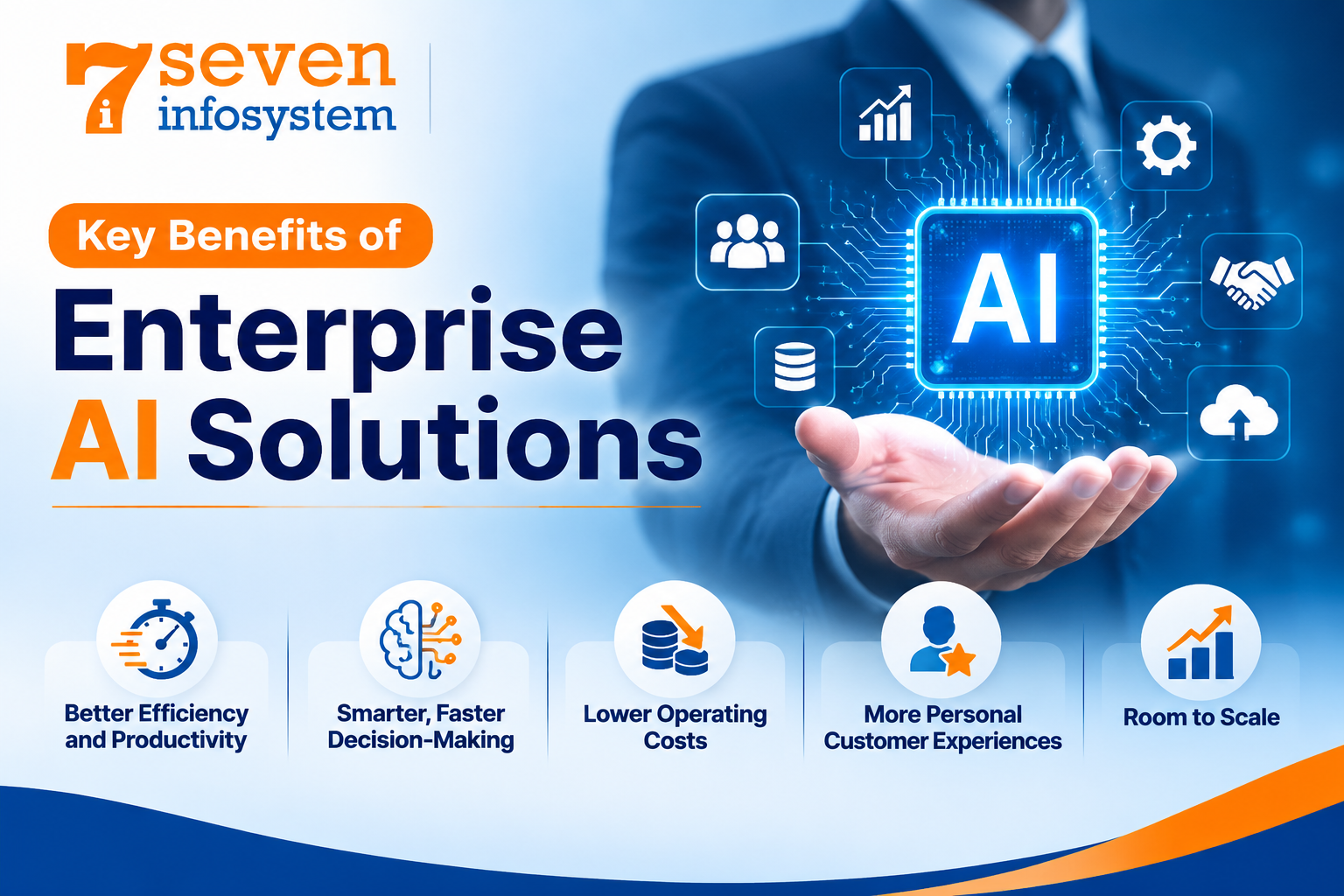
Better Efficiency and Productivity
One of the main benefits that companies appreciate at first is the time savings. Such activities as data inputting, invoice matching, and reports creation may be automated using ai automation software without much human effort required. This is when the true power of AI solutions for business efficiency becomes apparent.
Another aspect of this process is equally important. Employees will save time on transferring data between spreadsheets and will have more chances to engage in planning, decision-making, and customer relations. This is the essence of productivity of an enterprise ai software – not replacing employees but giving them back extra hours of the day.
Smarter, Faster Decision-Making
Organizations store far more data than any team can analyze using manual techniques. Through its ability to identify trends and important data, AI can provide management with immediate insights rather than requiring them to wait until a monthly report for analysis of a potential problem.
Lower Operating Costs
Automation decreases operating costs, while the predictive features of AI ensure that a company is not surprised by unexpected problems that could require costly repairs. Predictive AI can forecast when a machine might break down in a manufacturing facility, allowing the company to schedule maintenance.
More Personal Customer Experiences
Today, consumers expect an organization to recall who they are and respond to their needs quickly. Using AI, it is possible to personalize interactions, such as making product recommendations or providing support, for each customer.
Room to Scale
When the organization increases in size, the AI system can deal with greater amounts of information without requiring a proportional increase in staff. A bot that answers 500 questions daily can be set up to answer 5,000 questions.
Real-World Enterprise AI Applications Across Departments
To understand enterprise ai applications in the best possible way, one needs to consider their implementation by various departments. AI is not a tool meant for use by one particular department; it affects virtually all aspects of modern enterprises.
AI in Business Operations
Typical applications include demand forecasting, inventory management, logistics management, and quality control. Businesses can also use ERP software solutions to manage different business operations more efficiently. For example, a retail business might use AI to foresee which products might run out of stock in the festival season.
AI in Customer Service
Probably, the most obvious use case of AI in enterprises refers to the customer support and care department. Here AI allows chatbots and virtual assistants to answer customers' common questions 24/7, direct more complicated inquiries to a relevant agent, and even detect the frustration in the message of a customer in order to prioritize it. Human agents resolve complicated cases, however, they do it faster and with a more appropriate context.
AI in Data Analytics
Data by itself does not have any value until it makes sense to anyone. AI for data analytics enables users to process dirty data sets, identify underlying patterns, and create forecasts. Business people can now start asking questions in regular English like "What was the region with the lowest rate of growth in the last quarter?" without having to write a single piece of code.
AI in Financial Management
Financial departments work with a lot of transactions and demand for precision. AI for financial management enables fraud detection, expenditure auditing, cash flow forecast, and automatic reconciliation. The system will be able to spot an odd transaction right away, allowing the department time to act on it before money leaves the account.
AI in Sales and Marketing
AI in sales and marketing ensures that team efforts are directed toward the right audience and business goals. Lead scoring tools evaluate potential customers based on their likelihood of making a purchase. Additionally, marketing automation platforms help determine the best time to send emails and identify which audience segments are more likely to respond to a particular campaign. AI-powered content generation tools can also suggest advertising copy and social media posts, which marketers can review and edit before publishing.
AI in Human Resource Management
Acquiring and retaining top talent is a challenging task. In human resource management, AI can scan resumes, schedule interviews, answer employees' common questions regarding leaves or payroll, and identify early signs of employee burnout. Additionally, an HRMS system helps businesses streamline employee management, automate HR tasks, manage attendance, and simplify payroll processes. When combined with AI and proper human supervision, these technologies allow HR departments to become more flexible and reduce administrative workloads.
How to Choose and Build the Right AI Solution
While understanding how AI can benefit your company is important, finding the right solution that suits your needs is even more crucial. In general, businesses face two options: use preexisting enterprise ai platform or create the solution of your own.
Off-the-Shelf Platforms vs. Custom Development
The main advantage of enterprise ai platforms is that it is possible to implement ready-made products relatively quickly. These platforms are ideal for the tasks that require a standard solution, such as customer support chatbots or a sales forecasting tool.
Still, each business has its own process, data and goals that need to be accounted for. Hence, custom ai solutions were invented. In general, custom solutions are based on the way your company operates rather than requiring you to adjust your operations to the framework designed by some other firm. The majority of businesses choose hybrid solutions that involve both types.
Working with AI Development Partners
All organizations do not have their own data scientists. This is completely acceptable because ai software development companies can evaluate the preparedness of your business, choose the proper architecture, and develop systems that integrate well into your technology stack. In case of specific issues, you can use custom ai development services including data preprocessing, model training, deployment, and maintenance.
Things to Consider When Choosing an Enterprise AI Development Partner:
Experience in your industry or the same problem.
Process of handling data security and privacy.
Ability to conduct small-scale pilot projects first.
Post-release support as AI requires constant updates.
Steps for Smooth AI Integration in Business
Successful ai integration in business usually follows a few practical steps:
Start with a clear problem. Pick one process that is slow, costly, or error-prone and define what success looks like.
Check your data. No matter how good artificial intelligence may be, it cannot function without proper input data.
Run a pilot. Test the solution with a small team, measure results, and gather feedback.
Train your people. Help employees understand how the tool works and how it supports their roles.
Scale gradually. Once the pilot proves its value, expand to other teams or processes.
This step-by-step approach keeps risk low and builds confidence across the organization.
Common Challenges and How to Overcome Them
AI implementation can be difficult. Having an understanding of common issues makes it much easier to deal with them.
Data Quality and Availability
Quite many organizations realize that their data is dispersed in multiple systems, lacking some information or is simply inconsistent. This problem can easily be solved by spending more time on cleaning the data and creating one central source of data.
Privacy, Security, and Compliance
Often, AI applications deal with confidential information about customers and employees. Access control, encryption and data policy will be extremely helpful in this case. It also makes sense to select a solution that ensures compliance with local laws, such as Indian or European.
Skill Gaps and Change Resistance
Workers might fear being replaced by AI technology. Open communication is the best solution for this. If workers notice that the dull aspects of their job are being taken care of by AI and not everything else, then it would make it easier for them to accept it. Training can also help ease any concerns that employees might have.
Measuring Return on Investment
If goals were not set in the beginning, it will be difficult to measure the ROI of AI. Set measurable targets before you begin, such as reduced response time, fewer manual hours, or lower error rates, and track them throughout the project.
Future Trends Shaping Enterprise AI Solutions
The pace of technological advancement is increasing rapidly, and in the coming years, the Future of Technology will bring new developments that make AI solutions more powerful, practical, and valuable for businesses. Below are the key trends that will shape the development of Enterprise AI Solutions.
AI Agents That Complete Multi-Step Tasks
Initially, the technology responded to inquiries. Now AI has grown enough to act rather than react. AI agents are able to perform an ordered series of actions: reading a newly arrived order, checking its availability in stock, updating the system and sending an email back to the client – all without too much human interference. Such AI agents are expected to grow popular in operations, finance, and customer support.
Generative AI Becoming Part of Daily Workflows
Generative tools will no longer serve as research instruments; instead, they will be integrated into applications such as email, document editors, CRMs and project management tools. Workers will not need to switch to a separate application to receive the necessary help.
Industry-Specific Models
General models have great value; however, many businesses require AI that has an understanding of the language and principles within the industry, such as healthcare, logistics, banking, or travel. The specialized models, which are trained using the data from the particular industry, provide better predictions and results.
Responsible and Explainable AI
Since the use of AI in lending, employment, and setting prices will only increase in the future, companies will have to justify and demonstrate how these decisions are taken. These things will be included in the list of must-have features rather than optional ones.
Edge AI and Faster Processing
Processing AI data using devices like factory sensors, delivery trucks, or cameras in stores can help to avoid delays and protect private data. It is extremely important when there is no high-speed internet connection or any other problems with the internet.
Wider Access for Smaller Businesses
Nowadays, cloud services and reasonable pricing make business AI solutions available for small and mid-size businesses, not just for big corporations. In this way, companies can compete with each other on the level of service quality and speed of decision-making.
Closer Teamwork Between People and AI
In the future, there will be no replacement of humans by AI. Instead, there will be closer cooperation between the two parties. AI-based enterprise solutions will work as intelligent assistants, providing suggestions, drafts, and analysis, but people will decide.
Conclusion
AI has come a long way from being just a buzzword. Today, it has become a powerful solution for many enterprises because it helps reduce expenses, improve customer service, and increase employee productivity. Moreover, whether businesses focus on customer care, finance, HR, or marketing, AI offers numerous opportunities to achieve better results when implemented strategically.
However, successful AI adoption requires proper planning. Businesses must first identify their challenges, clean up their data, select the right platforms and tools, and prepare their teams for the transition. As a result, Enterprise AI Solutions can become a reliable driver of business growth rather than a risky investment.
Finally, if you are planning to introduce AI into your enterprise, start with small steps, evaluate the results carefully, and gradually expand successful initiatives. By following this approach, businesses can improve their operations and stay prepared for future technological advancements.
FAQs
1. What are Enterprise AI Solutions?
They are AI systems built to work across an entire organization, connecting with business data and software to automate tasks, support decisions, and improve efficiency.
2. How is enterprise AI different from regular AI tools?
Enterprise AI is designed with stronger security, system integration, scalability, and governance, so it can safely handle the needs of a full business.
3. Which departments benefit most from AI?
Customer service, finance, sales and marketing, HR, and operations usually see the quickest gains, though almost every team can benefit in some way.
4. Should a business choose an AI platform or custom development?
Platforms suit common needs and quick launches, while custom development works best for unique processes. Many companies use a combination of both.
5. Is AI affordable for small and mid-sized businesses?
Yes. Cloud-based tools and flexible pricing have made AI much more accessible, so smaller companies can start with a focused project and grow from there.