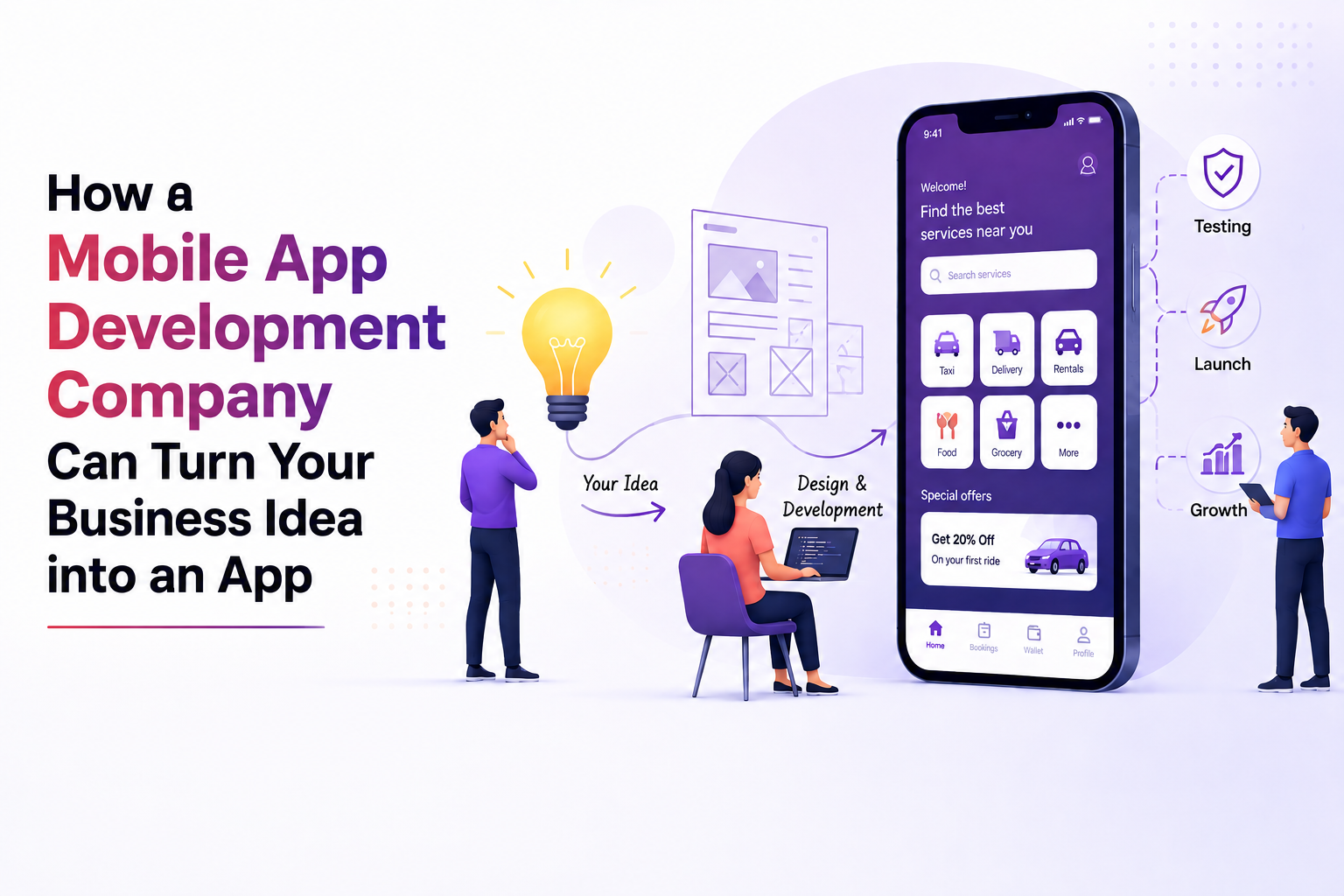
How a Mobile App Development Company Can Turn Your Business Idea into an App
Learn how a mobile app development company can turn your business idea into a successful app through strategy, design, development, testing, and launch.
It is necessary to admit that having an innovative business idea is just the first step to success. With the digital era, many consumers expect companies to provide a comfortable and quick experience using their smartphones. Whatever the idea may be – it can be about the creation of a delivery service, bookings app, online marketplace, fitness service, financial solution or any other application for existing businesses, it is important to understand that developing it into a successful mobile application will require more than programming.
There is always an opportunity to collaborate with a professional mobile app development company, which will assist in turning the early stage business concept into a useful and user-friendly application. From setting the business goals and conducting research on the target audience to design, development, testing, and post-launch promotion of the product, everything can be handled by an experienced development team.
The proper development team does not create an application following the instructions, it assists in analyzing and bringing to life the business idea.
Your Business Idea Is the Starting Point, Not the Final Product
Many entrepreneurs start with a simple idea: “I want an app which will solve this problem.” Even though the idea is highly valuable, most of the time it requires some improvement to make sure the development process goes smoothly.
Professional development companies first find out what is needed from this application. It can include the examination of your target audience, competitors, business model, potential income, features and overall goals.
For instance, you want to build a local service booking application. Having only registration, booking, payments and notifications might not be sufficient. Your development team needs to take into consideration the availability of the providers, location of your application, booking confirmation, cancellation policy, customer support, rating system, administration tools and automatic notifications.
Such a discovery period helps transform the idea into product vision.
Turning an Idea Into a Clear Digital Product Strategy
Conversion of an idea into a strategy makes its implementation easy. There is a company providing app development services which can determine the functions of an application, its target audience, and its advantage for customers.
It usually involves:
- Determining the main purpose of a business
- Defining the target audience
- Determining customer problems
- Analysing competitors' applications
- Choosing key features
- Determining the value proposition of an application
- Picking the right development methodology
- Planning future improvements
The idea is not to develop a bloated application full of unnecessary functions. It is better to develop an application solving real customer problems in order to support the business model.
Discovering What Your Customers Actually Need
The business owner might have a perfect understanding of the industry, but customers might have other expectations. Therefore, user research is crucial during the preparation of an app.
User research can help reveal how the potential users use similar applications, what annoys them, what features they like, and where the existing applications are lacking in fulfilling customer expectations.
For example, customers might prefer having a three-step procedure for making a reservation, instead of filling in the long form. They could need more payment methods, up-to-date information, saving of their preferences, or immediate customer service.
This knowledge can save a lot of money from unnecessary redesigning later.
The app is not created on the basis of the needs of the business owner, but on the basis of the needs of the users.
Shaping the Minimum Viable Product
The largest mistake that companies can make is attempting to pack all the available functionality into one initial product.
There is a mobile application development company that can assist in developing an MVP that contains the necessary functionality for testing out the business idea.
In case of a marketplace application, an MVP can include such functionality as:
- User registration
- Product or service listings
- Search functionality
- Basic ordering or booking
- Payment integration
- Notifications
- User account management
- Administrative controls
Such functions as advanced analytics, artificial intelligence, loyalty programs, automation, etc., can be added later.
By releasing a product with limited functionality, businesses will be able to get feedback from users and improve their product.
Building an Experience Users Want to Return To
Even the most technically advanced app may become useless if it is hard for users to use it.
Here comes the role of UI/UX design that is about the way the application is visually presented and how easy it is for users to perform their tasks.
There are a number of aspects taken into account by professionals including:
- Navigation structure
- Screen hierarchy
- Typography
- Buttons and interactive elements
- Forms
- Loading states
- Error messages
- Accessibility
- Mobile responsiveness
- Visual consistency
The idea is to make the app look natural, not complicated.
A customer must not need any additional explanation regarding where to click, how to search for something, and how to make a transaction.
Creating a Design That Reflects Your Brand
The mobile app must reflect the image of your brand. It means that the use of proper color schemes, fonts, icons, images, etc. will help you distinguish the application among other mobile products because users will immediately recognize it. Professional designers analyze your current brand identity and develop an interface for your application which looks nice and easy to navigate at the same time.
It is not enough that your app looks good. Moreover, the design of the application must convey the spirit of your brand as well as help users perform all the tasks easily. Good layout, correct hierarchy of visual elements, understandable buttons, convenient interaction will contribute to this result.
Choosing the Right Technology for the Application
Selection of technology could affect application performance, scalability, maintenance, and development costs.
Based on the specific project needs, a development company can advise using native, cross-platform, cloud technologies, APIs, databases, or others.
Native applications are applications that are developed specifically for a particular platform like Android or iOS, providing good performance in a specific environment.
Cross-platform application development is the technology used by companies developing applications for multiple platforms at the same time. It is useful when a firm wants to attract users from both platforms.
The following are considerations in selection of technology:
- Application complexity
- Platforms
- Performance requirements
- Budget
- Timeframe
- Integration requirements
- Long-term maintenance plans
It is an experienced team that considers all of these factors before choosing technology.
Connecting the App With Your Existing Business Systems
In most cases, a mobile app does not work as a separate system that does not need any interaction with the other applications or services used by your company. In most cases, the mobile app should integrate with the existing software, like CRM software, inventory systems, booking tools, payment gateway or customer database. Integration means that information exchange between the mobile app and your company's operations will be smoother and will eliminate unnecessary and boring work.
For instance, once the customer makes an order from the mobile app, the information about this order is transferred to the management system, updates the inventory, confirms the payment and informs the customer about that. As well, a booking app can be integrated with the availability systems so the customer gets the up-to-date information without the need for the manual maintenance of the information.
The professional company of mobile app development can develop APIs and third-party integrations that will fit your existing infrastructure and needs of your business. The idea is to create a connected digital environment in which the mobile app complements your business operations. The appropriate strategy of integration will make your business more efficient, less time-consuming, faster and more consistent for the customers and employees.
Making Security Part of Development From Day One
Such mobile apps usually contain very private information, including user credentials, contact details, payment details, and other personal data related to the clients or the operations within the company.
Therefore, security should be considered when creating the app.
The professional development team would be able to apply safe authentication procedures, encryption, access controls, safe API, data validation, and protection from the vulnerabilities of the application.
Regular security testing may also reveal potential weak spots in your future product.
In case you provide any financial services or work with sensitive customer data, this consideration becomes crucial.
Developing the Application Behind the Interface
This visible application is just an element of the product.
Every successful mobile application has a backend that is in charge of managing data, authentication, business logic, notifications, transactions, and inter-service communication.
For instance, when the user places an order for some service, there could be several processes occurring in the background. These could include verifying the user’s account, checking availability, making a booking, processing the payment details, informing the service provider about the booking, and updating the booking status.
Competent developers create such a background to enable proper application performance.
Testing Before Customers Start Using It
Deploying an app without adequate testing will unnecessarily cause problems.
These problems could range from app crashes, broken buttons, calculation errors, inability to log in, slow loading screens, or even payment difficulties. Such problems could result in low user satisfaction and negative feedback.
In a professional app development process, there are various types of tests such as:
- Functionality test
- Usability test
- Performance test
- Compatibility test
- Security test
- API test
- Device test
- Regression test
It is important to run a test on an application under different conditions because of the variation in the screens, OS versions, hardware and connection of mobile users.
But the purpose is not only about catching bugs but stability.
Preparing the App for Real-World Performance
The program might run perfectly fine for some users when tested; however, its performance could differ when many customers use the program.
When creating the application, scalability should be considered.
This can be achieved through cloud infrastructure, proper databases, efficient APIs, caching systems, load balancing, and correct application architecture.
The development company can develop the application in such a way that adding more users will not require redesigning of the complete application.
Integrating Payments and Other Essential Services
Most companies would require their applications to have support for transactions.
The app would have to be equipped with functions such as online payments, subscription services, refunds, invoices, wallets, or other transaction-based features.
The development team would be able to provide necessary payment services along with a transaction process.
Some other possible third-party integrations could be:
- Maps and location services
- SMS services
- Email services
- Push notifications
- Social media logins
- Analytics
- Customer service platforms
- Cloud storage
- Marketing automation systems
Such integrations could dramatically increase the functionality of an application.
Adding Intelligent Features When They Create Real Value
In modern applications, it is possible to include technologies like AI and machine learning; however, businesses should not include them just because they are popular.
AI may be useful if it solves a real customer issue or a business problem. For instance, in applications, intelligent recommendations, intelligent chatbots, personalized content, predictions, document processing, and intelligent search are some of the functions that can be included using intelligent technology.
A responsible software development company always determines whether such technology adds any value.
Launching the App Is Only the Beginning
The development process of an application does not end even after its launch into production.
It becomes possible at this stage to collect valuable information about the way in which the clients use the application.
Analytics will show:
- Which aspects of the app are used the most
- Where clients exit the app
- Which pages have technical issues
- How often clients return
- What channels are the best for customer acquisition
- What devices customers use
This data may be used for further development.
Thus, there is no need to make guesses about client preferences.
Using Feedback to Build Better Versions
User feedback is one of the most precious sources available after launch.
Users could ask for additional features, point out usability problems, notice missing features, or offer ideas on how to make things better.
The development company could organize all of this feedback and help set priorities.
The application could be further improved through each release cycle.
The first version would verify the idea. The second one could be used to improve usability. Future versions would add automation, personalization, integration, or other features.
The result would be a constant product development cycle.
How an App Can Create New Business Opportunities
An application may be used not only for digitizing the offered service but also to facilitate opportunities that have been hard to gain using regular business methods.
The application may facilitate:
- Direct customer engagement
- Digital payments
- Subscription models
- Loyalty programs
- Personalized offers
- On-demand services
- Online marketplaces
- Automated customer communication
- Data-driven decision-making
For instance, the business which used to rely heavily on phone bookings can provide the users with the opportunity to book services whenever convenient through an app.
The application thus serves two purposes – customer-oriented and business-oriented.
Selecting a Development Partner That Understands Business
Picking a development agency shouldn’t be purely guided by price alone.
An effective team would need to know about both technology and business.
Prior to making a decision, organizations could take into account:
- Previous mobile app projects
- Industry experience
- Technical capabilities
- UI/UX expertise
- Development methodology
- Communication process
- Testing practices
- Security approach
- Post-launch support
- Maintenance services
- Scalability expertise
An organization that is willing to ask a lot of questions about your users and your business model is more likely to create a product useful for you than one that starts from discussing features right away.
From Concept Sketch to Working Application
Developing an idea into a fully functional mobile app typically entails a series of stages.
A conversation between the business side and the discovery of a product might be the first stage. Other stages could comprise requirements analysis, user research, feature development, wireframing, UI design, technology stack selection, development, testing, release, and enhancement after the launch.
Every stage is part of the final product.
If some stages are skipped, it will lead to technical debt, user interface problems, extra costs, or even delays.
Avoiding Common Mistakes During App Development
There are several errors that organizations tend to commit while designing their first software application.
The first error involves the tendency to imitate competitors but without the knowledge of why such companies are successful.
Secondly, there is the case where some firms add too many features to their application without having proved that the idea is viable.
Thirdly, some firms tend to concentrate on aesthetics and forget about the performance, security, accessibility, and back-end structure of the application.
Failure to maintain the application is yet another problem that organizations commit. The mobile OS, third-party APIs, and customers' expectations keep changing.
Why Business and Technology Should Work Together
Successful mobile applications result from the merging of business insight with technical skills.
You know your clients, the market, the services, and your goals as a business. The development team knows about software design, mobile technology, user experience, integration, testing, and deployment.
By combining these perspectives, an idea will grow into much more than just an application.
A development partner will be able to question some of your assumptions, offer realistic alternatives, point out technical constraints, and offer solutions for your business as a whole.
This collaboration tends to work better than simple outsourcing.
Conclusion
Each successful mobile application starts from somewhere – either a business challenge, customer feedback or a single thought put on paper.
The gap between a mere thought and a useful digital product is how it is implemented.
A competent mobile app development company will be able to help you validate your idea, outline the required features, develop customer experience, use proper technologies, build safe functionalities, test the application, release it and optimize based on customer feedback.
The aim is not only to make your business available on a smartphone, but to create a useful digital product which will help to reach your strategic goals.
In case you have a business idea which has to be transformed into an application, then it is high time to start discussing the problem you have, customers you need and the results you expect to get. A well thought out plan and a competent technology partner will transform any idea into a useful mobile product.