What Is a Product-Based Company? A Simple Guide for Beginners
Learn what a product-based company is, how it works, its product development process, and how it differs from a service-based company.
Selecting the type of company one should work in could become confusing for novice specialists joining the tech industry. One might come across terms like product-based company, service-based company, software company, technology startups but not really know what the difference between them is. From all these types of companies, the Product-Based Company deserves special attention as an interesting option for students, recent graduates, developers, designers, marketers, and professionals seeking to build a career in technology.
The main point about a Product-Based Company is that it is oriented towards product development and improvement of products created by the company. The products could be any kind of technology-based product - from software applications and mobile apps to cloud platforms, digital products, consumer electronics, and enterprise solutions.
Unlike a Service-Based Company that develops a different solution for every single client, the company works on a product that will work well for a large number of people.
In other words, a company creates some kind of project management platform and offers its use to thousands of businesses as subscriptions. It constantly works on the platform according to the customers' demands, current market conditions, feedback and new technology.
Understanding the Meaning of a Product-Based Company
Product-Based Company designs and possesses a product that is intended to be sold on a market. In most cases, the product is developed having a certain segment of users and a certain problem in mind.
Depending on the type of industry, in the technology sector, the product might be a mobile app, a SaaS platform, financial technology product, e-commerce platform, communications tool, artificial intelligence product, cybersecurity product, or business management software.
The company is responsible for the development of the product and usually controls all aspects of product development including features, design, price, positioning, updates, and future development.
The main focus here is pretty obvious – the product itself becomes the core of the business.
The product starts with a limited set of features. When more and more people start using it, the company collects the feedback from users, analyses their behaviour, finds problems and implements solutions. This forms the continuous product development cycle instead of one-time project completion.
How a Product-Based Business Actually Works
The lifecycle of a product always starts with problem identification or an opportunity. The company does its market research and asks itself a question about which problem can be solved more effectively or more conveniently.
Once the opportunity is determined, the team consisting of product managers, designers, engineers, researchers, marketers, and the business side works together in order to design a solution.
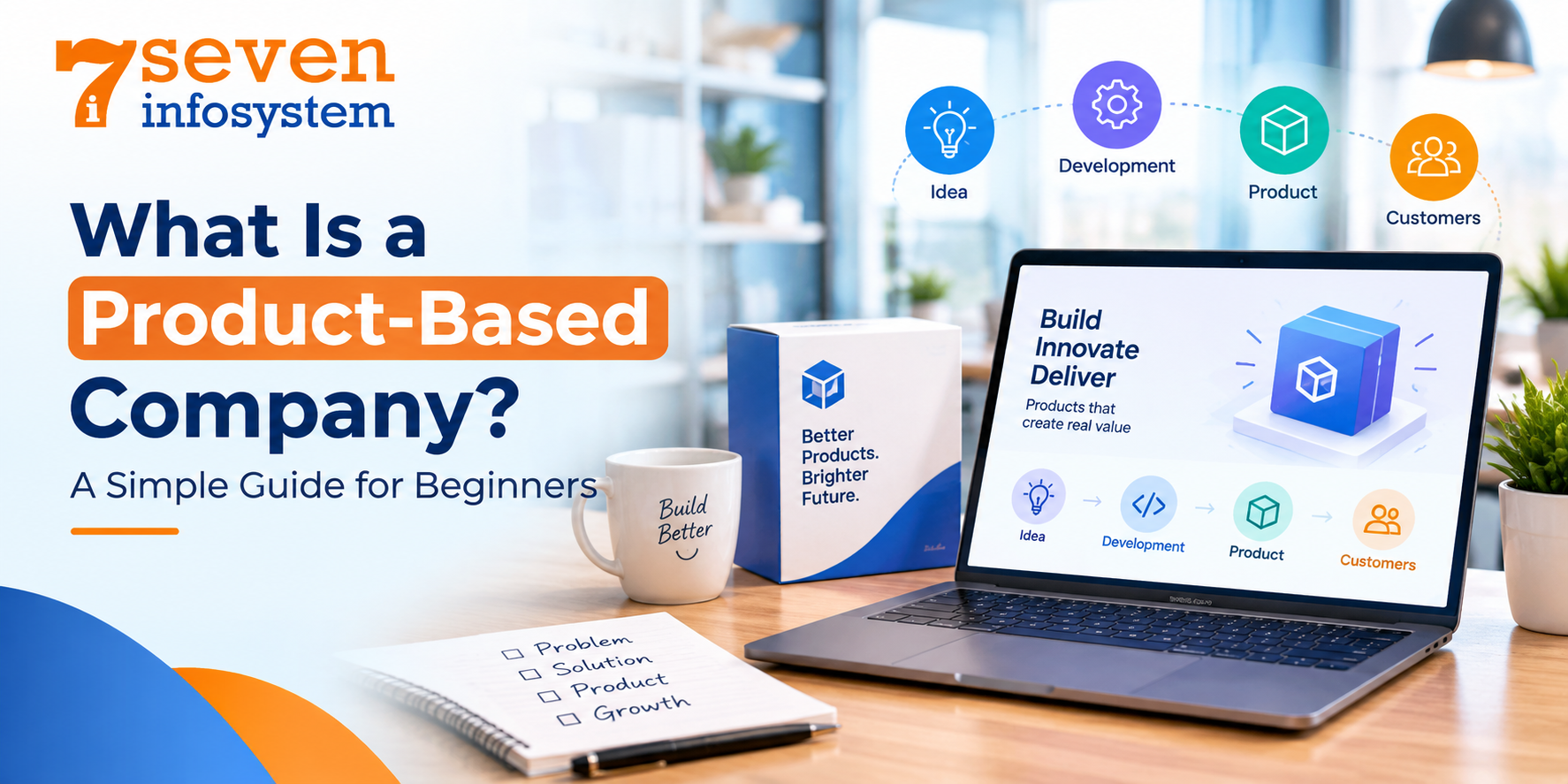
Typical product lifecycle consists of the following steps:
- Market research: understanding customers, competition, trends, solutions etc.
- Problem identification: defining the problem to be solved
- Product planning: deciding about features and capabilities to be included
- Design: designing user experience, user interface, workflows, structure
- Development: engineers develop the product according to chosen technologies
- Testing: identifying bugs, vulnerabilities, usability issues, performance issues etc.
- Launch: releasing the product on the market
- Customer feedback: receiving feedback from the users helping to determine opportunities for improvement
- Continuous improvement: developing new features, bug fixes, integrations etc.
This process can be repeated many times and there is no product which can be said to be developed fully. Successful product development is always the ongoing process.
Product-Based Company vs Service-Based Company
An easier way to grasp what a Product-Based Company means for people who are just starting out is through the comparison of this type of business with a service-based business.
In a service-based company, there is always a client who needs something done. The client comes to the company and expresses their need and the company helps them out with development, consulting, design, marketing, maintenance, and any other professional services.
In a Product-Based Company, there usually is a product developed by the company and that product is sold to a large number of customers.
It can be illustrated using a very simple example.
Imagine that someone needs a special inventory management system for their business. In a service-based technology company, they will develop such an application especially for this business according to their needs. After the project is completed, they will either go into maintenance or start working on another project.
A Product-Based Company will develop a standard inventory platform which can be used by thousands of businesses at once and which does not need to be changed for each and every single client.
| Product-Based Company | Service-Based Company |
| Builds and owns its product | Builds solutions for clients |
| Product is central to the business | Client requirements are central |
| Usually serves many users through one product | Often handles multiple client projects |
| Focuses heavily on product improvement | Focuses heavily on project delivery |
| Decisions are driven by product strategy and users | Decisions are often driven by client requirements |
| Product teams may work long-term on one platform | Employees may move between projects |
There is no automatic superiority to either model. Both provide useful professional experience, but the work environment and tasks may differ.’
Why Companies Choose the Product-Based Model
To create a product one needs significant investments, research, experiments, and patience. However, why would companies opt for such a model?
There are many reasons, but one of the biggest of them is scalability.
If the company has created something useful in the form of a digital product, then it will be able to offer or sell this product to thousands or even millions of people without developing a completely new solution for each customer.
For instance, a software platform available on the cloud can be used by customers located in different cities or even different countries. After developing the initial infrastructure of the product, the company will be able to constantly improve it and reach more customers.
Scalability can also lead to recurrent income since many modern software products use a subscription fee for using the platform (monthly or annual payment).
However, scalability does not guarantee success since the product business is quite competitive and requires understanding of customer needs, maintaining the quality of the product, security of the user information, managing the infrastructure, and developing improvements.
The People Behind a Product
A popular beginner misconception is that product companies consist mainly of programmers. In fact, most successful products are developed by multidisciplinary teams.
Various specialists are involved in various stages of the product life cycle.
Product Managers
Product managers clarify what to build and why. They analyse customers' problems, business goals, market opportunities, and product performance.
The duties of a product manager might include prioritization of features, communication with various teams, etc.
Software Developers
Developers translate product ideas into actual software products. The team depends on the type of the product and may include frontend developers, backend developers, mobile developers, full stack developers, cloud engineers, DevOps engineers, and other engineers.
Their duties may vary from coding to system design, from API integration to system optimization, and bug fixing.
UI/UX Designers
A product should be comprehensible and convenient for the users. UI/UX design work in the field of the user-product interaction.
Their tasks may include the development of wireframes, prototypes, user flow, visual design, design system, and improvements of usability.
Quality Assurance Specialists
Testing is critical since customers expect reliable operation of the product.
Testing engineers are responsible for checking such aspects of a product as functionality, usability, compatibility, performance, and others. Automation engineers develop automated tests.
Marketing Teams
Even an ideal technical solution requires customers.
Marketing specialists assist in presenting the product's benefits to the market. The duties of marketing professionals include content marketing, SEO, social media, advertising, email campaigns, branding, and market research.
Sales and Customer Success Teams
Sales people assist in acquiring customers, especially when the product is targeted to businesses. Customer success specialists assist users in understanding and getting benefit from the product.
These specialists might provide feedback to product and engineering teams.
What Makes Product Development Different?
Traditional projects focus on providing a solution to meet certain requirements. The development of a product is usually iterative.
The initial idea is based on some assumptions on what customers need. Upon release of the feature, real users' behavior can indicate that the original assumptions were not correct enough.
The company analyzes the outcomes and determines how to improve them.
Such process forms an iteration cycle:
Research → Planning → Design → Development → Testing → Release → Measuring → Improving
It can go on for years.
One of the reasons why product teams tend to focus on analytics, feedback from customers, metrics of the product, usability testing, and trends on the market is this process.
The Role of Technology in a Product-Based Company
Technology is generally a key element of any Product-Based Company.
Different companies will need different technologies according to their products. For example, an app needs Android or iOS development whereas web platforms require front-end and back-end technologies. There may also be cloud platforms, databases, APIs, artificial intelligence, cybersecurity, analytics, and automation.
However, technology selection is not just popularity based. Performance, scalability, security, maintainability, development speed, cost, and future needs of the product are among criteria teams might use.
What this means for beginners is that there is more to being a technical professional in a product company than coding.
A developer might need to know how:
- Users use the product
- Why they are developing a certain feature
- Technical decision impacts performance
- Systems behave in large scale
- Security should be maintained
- New functionality impacts users
- Production systems should be monitored and troubleshooted
Such broad knowledge can make developers better problem solvers.
Product Decisions Are Often Based on User Problems
The key characteristic of product development is problem-solving for users.
Let us consider an example of a travel app in which the booking process fails because the payment page is confusing for users. This can be found by a product team using analytics, talking to customers, or usability research.
Instead of just adding one more feature, the team can improve the entire flow of payments.
In that sense, product development is not about making a product with as many features as possible. It is about delivering value to users.
Sometimes it may be better to have a product with less but properly implemented functionality rather than too many features.
How Customer Feedback Shapes a Product
The customer is not merely a buyer but may well become a valuable source of information about the product.
The feedback may provide insight into:
- Features that are hard to use by customers
- Problems overlooked in testing
- New requirements coming up on the market
- Factors making the customer stop using the product
- Future features wanted by customers
- Areas for improvement of the customer experience
It is impossible for companies to meet all of their requests.
A product team should analyse feedback in light of business goals, technical possibility, demand from the market, and product strategy.
That’s why product management entails much prioritizing.
Understanding the Product Development Lifecycle
A novice may ask what follows after the product concept is approved. And this, again, depends on a specific organization; however, many companies stick to the well-defined product development life cycle.
Research and Discovery
Teams start researching the problem. They analyze competitors, conduct user interviews, analyze the market and existing solutions.
The main point is to find out whether there is a real issue that would be worth investing time into.
Product Planning
When it is established, teams formulate the objectives and the set of capabilities that need to be built.
The big vision is split into smaller requirement sets that can be designed, developed, tested and released.
Design and Prototyping
Teams come up with several designs and prototypes. In this case, it is possible to test the solution before developing the feature.
The prototyping approach helps teams find out issues with the usability of the feature at an early stage.
Engineering
Developers implement the functionality according to the plan. Engineering teams might work in iterations, usually referred to as sprints, depending on the methodology of the company.
Code reviews, testing, documentation and technical discussions could be included into the process.
Quality Testing
Product is tested for the correct implementation of changes and absence of regression bugs.
Testing might occur during the whole development process and not only at the final stage.
Release and Monitoring
The product is released after its approval.
Teams track performance, bugs, user interaction and other related metrics to evaluate whether the release has met the goal.
Optimization
Product is continuously improved based on the obtained results.
Here, the product life cycle turns into an ongoing process and no longer a single project.
Why Data Matters in Product Companies
Data can have a considerable impact on product decision-making.
In place of decisions based on mere speculation, one can base them on measurable data which includes factors like user interaction, conversion rate, retention rate, response rate, usage of features, customer satisfaction, and revenues generated.
For example, when a company launches a feature, but few people end up using it, more research and analysis would follow.
Reasons can include lack of visibility, complex onboarding process, little utility, and incompatibility of the feature with what users need.
Data is not meant to substitute the decision-making process of humans, but it serves as a great tool in it.
Skills That Can Help You Enter a Product-Based Company
In case you are a beginner wanting to work at a Product-Based Company, try to build a balanced set of technical, analytical and communication skills.
Technical Skills
Fundamental skills are very important for jobs in software development.
Depending on the specific job profile you want to work in, you need knowledge about programming languages, databases, APIs, data structures, algorithms, web technologies, mobile technologies, cloud platforms, etc.
Problem Solving
It is important for companies to hire individuals who are capable of comprehending problems and devising appropriate solutions to them.
The skill to dissect any complex problem into smaller portions is beneficial for almost all technology roles.
Product Mindset
Programmers who understand the user's problem can usually make more informed technical decisions.
Some questions to ask are:
- Who would be using this feature?
- What is the problem that it solves?
- What happens if this feature does not work?
- What would be the experience of users due to this change?
- Would the solution scale?
- Are there any risks associated with it?
Communication
Good communication is an advantage as far as explaining technical aspects, balancing alternatives, teamwork and knowing requirements.
Flexibility
The technology and customers both change quickly.
Individuals who are ready to learn new things and adapt accordingly keep themselves relevant.
The Future of Product-Based Companies
There are likely to be further developments in the industry of products as technology becomes increasingly embedded in our day-to-day life and processes.
New possibilities for product development are created through cloud computing, artificial intelligence, automation, data-based decision-making, Internet of Things, cybersecurity, and digital platforms.
Along with this, competition is set to increase even more.
Since there is an increased number of options in front of the customers, it is important to offer them something valuable as opposed to merely marketing.
The upcoming products will give consideration to such factors as personalization, automation, security, accessibility, performance, and intelligent customer experience.
This requires professionals to keep developing themselves.
Conclusion
Product-Based Company is the term for an organization that designs, creates, develops and improves the product to use it in a target market. From the point of view of the tech industry, such a product can be any piece of software, mobile app, Saas, digital marketplace or other tech solution.
One of the most significant differences between product and service companies is the focus of their work. A service company is centered on providing clients with solutions, whereas a product company is focused on developing and improving its product.
For a beginner, it becomes clear that such knowledge of the difference will make career choice simpler. He/she will understand what kind of environment he or she should seek for, which skills to develop and what kinds of problems to expect there.
A quality product is not created just by writing a code. Such a product requires research on the problem, design, development, testing, marketing, knowledge of the users and clients and continuous improvement.
If you are planning to make your career in technology, then it is better that you understand the process better. To do this you should start to think broadly, understand users, study problems, create solutions, measure the results and always be ready to improve.