7 Stages of Software Product Development Explained
Discover the 7 stages of software product development, from idea validation and planning to design, testing, launch, and ongoing maintenance.
Introduction
All the applications in your smartphone and all tools you use in your job were originally ideas written on the whiteboard. Bringing those ideas to life by creating something people will be willing to buy, depend on, and promote requires much more than coding. It requires a well-planned strategy, research, design, testing, and continuous efforts of improvement.
This process is called software product development. And when done without care and thoroughness, its outcomes are known to everyone – the budgets are exceeded, deadlines are missed, and end-products become a failure. When performed the right way, it leads to successful and quick delivery, smart investments, and high-quality software.
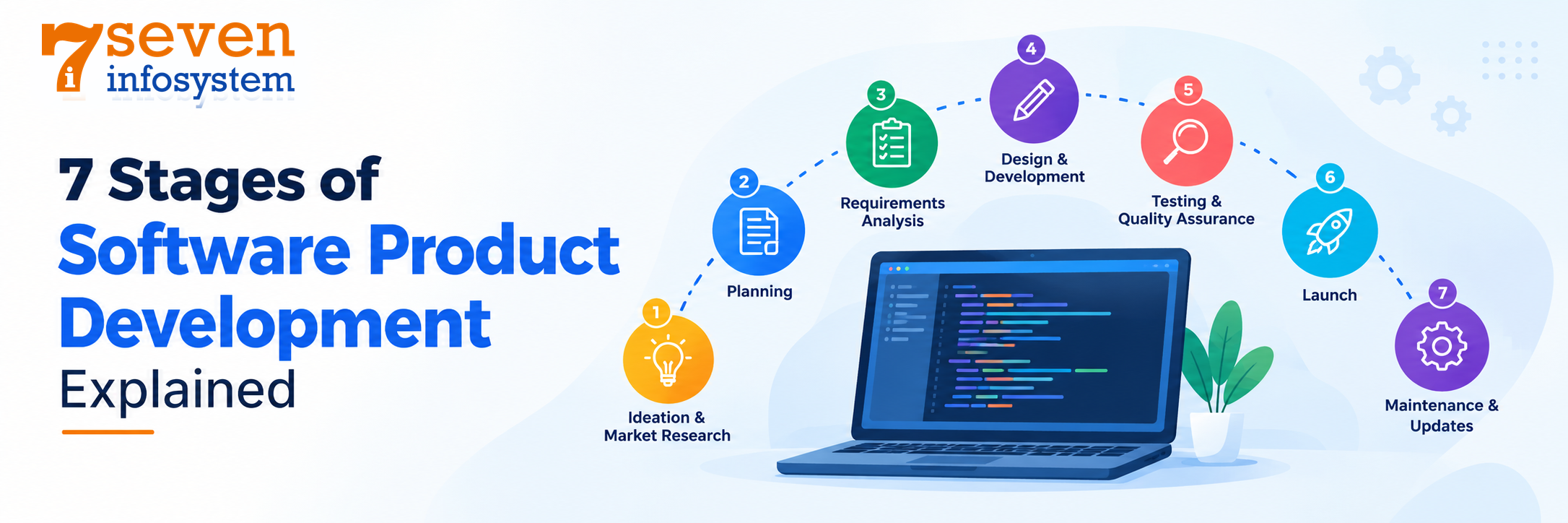
Seven stages of product development from scratch to maturity. Regardless of whether you are a startup founder designing your first minimum viable product, product manager looking for ways to improve your workflow or a company owner thinking of developing a software product in collaboration with another party, you will get to know the details of the process.
What Is Software Product Development?
Software product development is the whole process of creating software products, from initial concept through design, development, testing, launch, and updates in subsequent stages. Here the term "product" becomes critical. In contrast to one-off custom solutions or projects for clients, where the scope is predefined, software products are intended for market. They have their target audience, competition, business model, and further roadmap.
It makes a huge difference in how such projects are managed. Whereas teams developing one-off solutions usually wonder, "Does it work?", those working on products care about questions like: "Will people use it? Will they pay for it? How will it develop within the next three years?"
Why a Structured Process Matters
A software product development process that is structured will provide everyone involved, from developers to investors, with a common vision of what is going on. It will help you:
Minimize risks of failure due to validation of ideas at an early stage
Manage costs, as early detection and solution of issues is way cheaper than fixing them later
Increase the quality of a product through timely testing
Speed up delivery since each team knows what comes next
Keep stakeholders aligned with clear goals, milestones, and decision points
Product Lifecycle vs. SDLC: Is There a Difference?
It is not uncommon for the software product development lifecycle to be discussed together with the traditional software development life cycle (SDLC). There is indeed a great deal of overlap, but a small difference exists between the two terms. While SDLC refers primarily to the activities that fall under the scope of engineering, including requirements analysis, design, implementation, and deployment, the product lifecycle encompasses all that along with other activities.
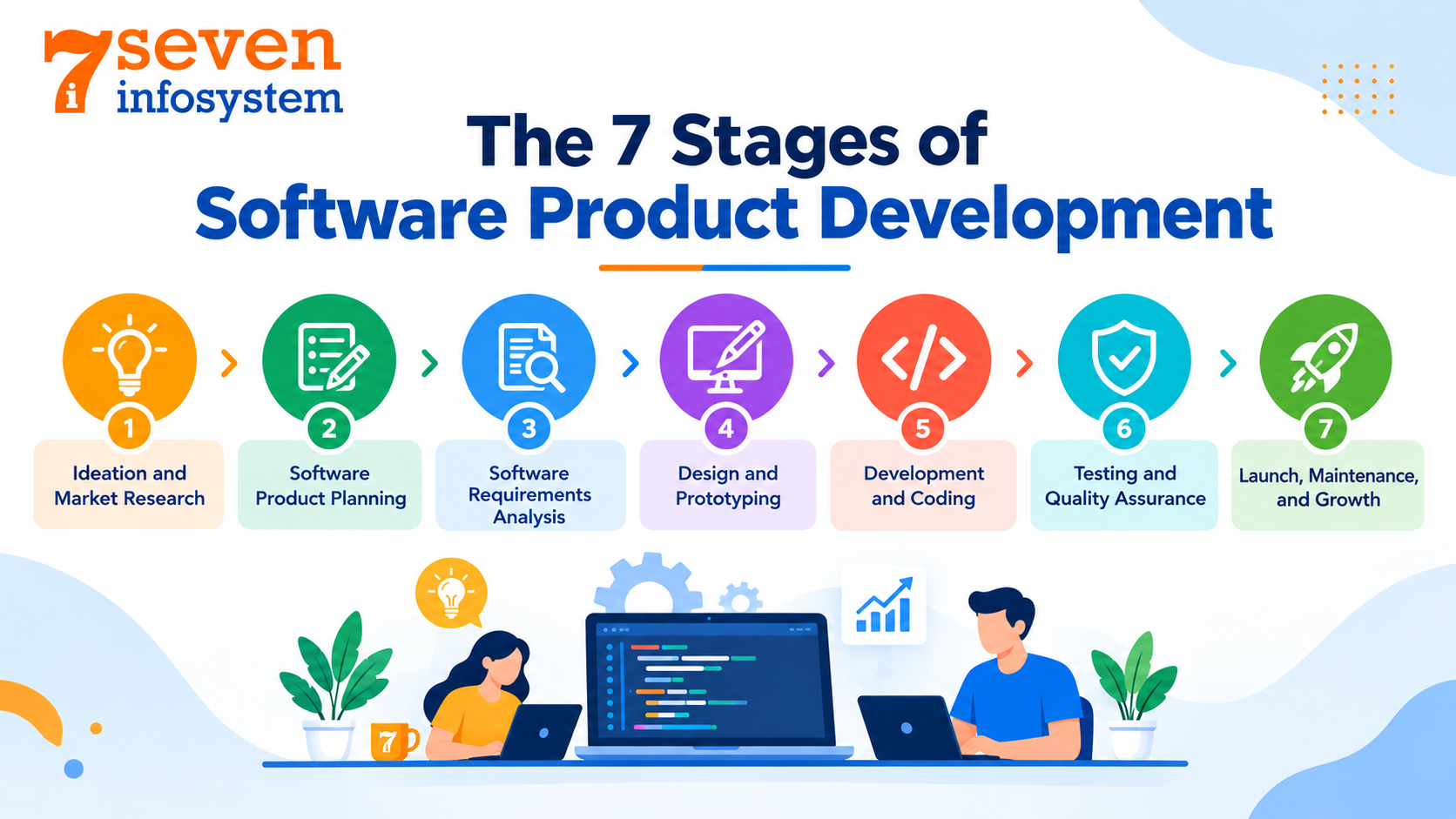
The 7 Stages of Software Product Development
There may be variations in nomenclature, but most successful companies go through the same 7 essential software product development phases . Let's see what each of them looks like in practice.
Stage 1: Ideation and Market Research
Every product starts with an opportunity to solve a problem worth addressing. The aim of this phase is not to fall in love with your idea, but to verify if the idea has any right to exist.
Teams typically:
Interview prospective users about their pains
Analyze competitors in order to spot gaps, weaknesses and pricing
Estimate the market and find your ideal customer
Conduct experiments, e.g., create a landing page or survey to validate the idea
The basic question of this stage is very straightforward: who has this problem, and how urgently they need it to be solved? If you don’t have a clear answer, it's wiser to adjust your idea at this stage, rather than invest months into development of something people don't actually want. Bad product ideas didn't fail due to poor coding; they failed because they addressed problems nobody needed.
Stage 2: Software Product Planning
Now that we have a potentially viable idea, we need to make a plan out of our excitement. A good software product plan will give us direction without constraining us to premature decisions.
Key outputs of this stage include:
Product vision: a brief description of the product and its purpose
Scope and MVP definition: the minimum version that provides some value
Roadmap: a high-level release schedule
Budget and resources: number of people on the team, tools, etc., costs
Risk analysis: technical, business, and marketing risks, along with contingency plans
This is when you choose a development approach. The agile methodology is best suited for most products since it lets you get feedback and correct your strategy along the way. In some cases, the waterfall approach works, especially if your requirements are well-defined.
Stage 3: Software Requirements Analysis
Planning helps you know where you want to go. The next step, software requirements analysis, helps you understand precisely what to build to reach your destination.
At this stage, business analysts, product managers, and technical leads collaborate in order to write down:
Functional requirements: things that need to be done by the software, for example, user registration, file uploads or payment processing
Non-functional requirements: requirements related to performance, including speed, security, scalability, and accessibility
User stories: short user-focused explanations of features, for example: "As a manager, I want to export reports to be able to send them to my team"
Acceptance criteria: precise conditions under which feature can be considered implemented
This stage is crucial. Poorly defined requirements are one of the top reasons why a project goes over budget. If developers have to make guesses about how some feature should behave, chances are high that they will make a mistake, and rectifying the problem later will cost much more than defining everything properly from the very beginning.
Stage 4: Design and Prototyping
With all of the requirements in mind, the development team begins thinking of the product from a visual and technical perspective. This stage includes two aspects of design.
User experience and interface design. Designers create wireframes, user flows, and visual mockups. Then they build clickable prototypes that real users can try. Early feedback here is incredibly valuable, since changing a screen in a design tool takes minutes while changing it in finished code can take days.
Second, it is the technical architecture decisions made by architects regarding the choice of the technology stack, database schema, APIs, cloud infrastructure, and security model.
In most companies, software product design and development processes are closely related. Designers continuously work on the screens, while developers build technical systems, and both of them have constant communication.
Stage 5: Development and Coding
This stage comes to mind when people think of software development. The programmers write the code to implement the designs and requirements.
In an Agile setup, work is broken into short sprints, usually one to four weeks long. Each sprint delivers a small, working piece of the product. A typical sprint includes:
Sprint planning where tasks are picked from the backlog
Standups daily where progress is shared and impediments are removed
Coding, code reviews and continuous integration
Sprint review where completed work is demonstrated
Sprint retrospective where lessons learned are discussed
Strong teams also rely on version control (like Git), automated builds, and clear coding standards. These habits keep the codebase clean and make it easier for new developers to join without slowing everyone down.
Stage 6: Testing and Quality Assurance
Testing should not be a checkpoint, at the end. The best teams test continuously throughout development. Still there is usually a phase before the product is released where quality assurance receives extra focus.
Common types of testing include:
Unit testing checks pieces of code
Integration testing confirms that modules work together
Performance testing shows how the system handles heavy traffic
Security testing to find vulnerabilities before attackers do
User acceptance testing (UAT) where real users confirm the product meets their needs
Automated tests catch regressions quickly, while manual testers spot usability issues that scripts can miss. Together, they help ensure the product works not only in ideal conditions but also when users do something unexpected, which they always will.
Stage 7: Launch, Maintenance, and Growth
This final stage consists of two processes: delivering the product to the end user and maintaining the product after release.
The Software Product Launch Process
It is rare to achieve a successful product launch without much planning. An effective software product launch process can be expected to include the following:
A beta or soft launch with a group of users
The final deployment to production servers or app stores
Marketing campaigns, documentation, and onboarding materials
Support channels ready to answer questions on day one
Monitoring tools to track errors, performance and user behavior
Software Product Maintenance
Launch day is the beginning of a product’s journey, not the end. Software product maintenance keeps the product secure, stable, and relevant over time. For example, it includes fixing bugs, applying security patches, improving performance, updating compatibility for new devices and operating systems, and adding features based on user feedback.
Moreover, software product maintenance should be considered part of the product’s total cost throughout its lifecycle. Therefore, businesses should plan for maintenance from the very beginning. Regular updates and improvements help build user trust and ensure a smooth experience. However, products that are neglected may develop security vulnerabilities, performance issues, and compatibility problems over time.
How to Develop a Software Product That Lasts
Understanding the stages of the software development life cycle stages is one thing. Doing them well is another. If you are trying to create a software product that people keep using these habits really help:
Start small and validate: Put out a viable product, find out what people really do and then add more features. Making all the features at once usually means making a lot of things that people don't want.
Keep users in the loop: Ask for their thoughts at every step not just after it is out. Quick chats and tests show issues that the people working on it miss.
Write things down: Good notes about what's needed, what choices were made and how the system is built save a lot of time when people on the team change.
Automate where you can: Testing and sending out updates automatically cut down on mistakes. Let teams put out changes with more trust.
Treat security as a feature: Add it to the plan and the code, from the beginning instead of fixing problems later.
Measure what matters: Watch numbers like how many people're still using the product, how many come back and how often things go wrong so decisions are based on facts and not just guesses.
Choosing the Right Software Product Development Company
However, not all businesses have their own development team capable of executing all seven stages. Here is where a software product development company can step in. A proper software development company is one whose designers, engineers, testers, and project managers have already faced and managed to overcome the similar issues.
When evaluating different vendors, pay attention not only to price but to such aspects as:
A portfolio which includes products of a similar scale or industry as yours
Process clarity on how they develop, test, and monitor the progress of the product
Good communication with updates, demos, and one single contact person
Technical proficiency covering the entire stack including front end development and cloud infrastructure
Aftercare support which prevents the product from becoming stagnant after release
Code and intellectual property ownership agreement
Ask for client references. If possible, talk directly with people who have worked with them before. A short paid discovery phase is also an idea to see how the working relationship goes before making a full commitment.
In-House Team or Outsourcing?
Both options can be beneficial, depending on a company’s goals, budget, and resources. An in-house team develops a deep understanding of the product and provides greater control over the development process. However, hiring skilled professionals takes time and can increase operational costs.
On the other hand, outsourcing provides access to experienced professionals and offers greater flexibility. For example, this approach is particularly useful for startups and businesses exploring new technologies because they can access specialized skills without building a full in-house team. Moreover, some companies choose a hybrid approach to get the best of both options. In this model, the company manages product strategy internally, while an external partner handles design, development, and testing.
Conclusion
Great software doesn't happen by accident; instead, it results from a thoughtful and well-planned journey. First, the process begins with market research to understand user needs and identify opportunities. Next, careful planning and clearly defined requirements help establish a strong foundation. Furthermore, designing with users in mind ensures a better experience, while building in focused cycles allows teams to improve the product step by step. Finally, thorough testing and ongoing maintenance help keep the product reliable and valuable long after launch.
Moreover, each stage of software product development depends on the one before it. If a step is skipped, problems can emerge later and become more expensive to fix. Therefore, following a structured process is essential for long-term success. Businesses should also stay connected with their users and remain flexible because feedback and changing needs may require adjustments along the way.
Whether you build a product with your in-house team or partner with an experienced development firm, following these seven stages gives your idea a stronger chance of becoming a successful product that people truly value.
FAQs
1. How long does it take to build a software product?
A simple MVP may take three to six months, while complex enterprise platforms can take a year or more. The timeline depends on scope, team size, and how quickly decisions are made.
2. What is the most important stage of the process?
Every stage matters, but requirements analysis often has the biggest impact. Clear requirements prevent costly rework in design, coding, and testing.
3. What is an MVP, and why should I build one?
An MVP (minimum viable product) is the simplest version of your product that solves the core problem. It lets you test demand and gather feedback before investing in a full build.
4. How much does software product development cost?
Costs vary widely based on features, complexity, technology, and team location. Small MVPs may cost tens of thousands of dollars, while large platforms can run much higher.
5. Does the work end after the product launches?
No. After launch, the product needs ongoing maintenance, security updates, and new features to stay useful and competitive.