Android App Development Trends: What Businesses Must Know
Discover the latest Android app development trends shaping modern businesses, from AI and machine learning to cloud, IoT, AR, voice, security, and enterprise applications. Learn about development costs, processes, and key considerations for building scalable Android apps.
Introduction
Android remains an important platform for businesses that want to reach customers through smartphones, tablets, smart devices, and other digital channels. As user expectations continue to evolve, businesses need Android apps that are fast, secure, personalized, scalable, and easy to use.
Modern Android Application Development, however, is no longer limited to building applications with basic functionality. Instead, technologies such as Artificial Intelligence, Machine Learning, Cloud Computing, the Internet of Things (IoT), Augmented Reality, Voice Interaction, and advanced security are increasingly influencing how Android applications are designed and developed.
From a business perspective, keeping up with the latest Android Application Development Trends is not simply about adopting every new technology. Instead, it is about understanding which technologies can improve customer experiences, streamline business operations, strengthen security, and create measurable business value. For example, AI and machine learning can help businesses deliver more personalized experiences, while cloud technologies can support scalability and flexible infrastructure.
In addition, businesses may have different requirements depending on their goals. A company may need a customer-focused application, an internal business tool, or a complex enterprise solution. Therefore, selecting the right application development partner can make a significant difference. Experienced Android Application Development Services can help businesses build applications with the essential features, while also ensuring that the solution is designed around usability, scalability, security, and long-term business needs.
What Is Android App Development?
Android app development is the process of designing, building, testing, deploying, and maintaining applications for devices that use the Android operating system.
The typical Android app development process involves key steps. First there is business and user research to understand the needs and goals. Then comes product planning to define the features and scope. Next UI/UX design is done to make the app easy to use and visually appealing. After that the app is. Tested before deployment to app stores or other platforms. Finally ongoing maintenance and updates keep the app working and improve it over time.
A typical Android App Development Process includes:
- Business and user research
- Product planning
- UI/UX design
- Deployment
- Maintenance and updates
Modern Android applications can also integrate technologies such, as intelligence, cloud services, APIs, machine learning, IoT augmented reality and biometric authentication.
For businesses professional Android App Development Services can transform an application idea into a digital product designed around specific customer or operational needs.
Why Android App Development Trends Matter for Businesses
Trends in technology can help businesses get customers, provide services, manage their operations, and compete in the digital market.
For instance, AI-based Android apps can customize the recommendations and automate the customer service. The integration with cloud can help build an easy-to-scale infrastructure for backend, while modern authentication can enhance the application security.
Having knowledge about the existing trends will allow a business to understand whether it needs to implement Custom Android App Development Services rather than use any generic technology. The custom app can be designed according to the business workflow, customer needs, integrations, and future goals of the company.
The technology that a company uses should be chosen based on its business goal, which might include:
- Improving customer engagement
- Increasing conversions
- Automating repetitive tasks
- Reducing development and maintenance costs
- Supporting business scalability
How Android Apps Are Changing Customer Expectations
Android users now expect apps to be quick, easy to use, tailored and dependable. Hard navigation, speed, too many permissions and bad experiences can make users leave an app.
Users also expect convenient features such, as:
- Personalized recommendations
- Biometric authentication
- Real-time notifications
- Digital payments
- Voice interaction
Businesses must concentrate on the whole Android user experience instead of just building an app with many features.
This is why Android Mobile App Development is now closely linked with user experience, speed tuning, safety data analysis and ongoing product upgrades.
Key Factors Driving Android App Development in 2026
Important Aspects Behind Android Application Development in 2026
There are several aspects influencing the development of Android applications in the future.
Artificial Intelligence: The role of artificial intelligence will become more significant in terms of personalization, automation, recommendations, analysis, and assistance.
Higher Levels of Security Needed: There are many kinds of personal, financial, and corporate information stored by Android applications, which explains why security matters a lot now.
Multidevice Experiences: Android applications become popular not only in smartphones but also in tablets, wearable gadgets, television, car computer systems, and so on.
Faster and More Effective Development: Companies prefer development methods that help avoid redundancy and facilitate application maintenance in the future.
Top Android App Development Trends Businesses Should Know
AI-Powered Android App Development
Artificial Intelligence is one of the important trends that shape modern Android application development.
AI can help Android applications:
- Personalize content
- Recommend products and services
- Automate customer support
- Detect unusual activity
- Analyze user behavior
For instance, an e-commerce Android app can utilize AI to make recommendations depending on browsing and purchasing activities.
Companies should pay attention to useful AI implementations that address customers' or business challenges rather than add popular AI features just for the sake of popularity.
Generative AI in Android Applications
Generative AI opens up possibilities for Android applications. With Generative AI businesses can build assistants summarize information, generate content, analyze documents and offer contextual support.
By moving through many screens users may interact with an Android application using natural language.
For example an employee using a business application might ask a question about sales performance. Get a concise answer that comes from relevant business data.
The key challenge with Generative AI is making sure that AI-generated experiences are useful, reliable, secure and appropriate, for the Android application.
Machine Learning and Personalized Experiences
The use of machine learning in Android applications allows developers to detect usage patterns and create more customized experiences.
Shopping, entertainment, financial, healthcare, and content applications can use machine learning to personalize recommendations and interactions.
Businesses can potentially improve engagement by showing users content or services that are more relevant to their interests.
Kotlin and Modern Android Development
Kotlin is a vital tool for modern Android development. The concise syntax, Java interoperability, and use of contemporary development tools make Kotlin a good choice for developing modern Android apps.
Development technology needs to be selected based not only on its popularity but also on the following aspects:
- Developer availability
- App requirements
- Maintenance
- Performance
- Scalability
- Integration
Selection of the right technology base will make development and maintenance of apps easier in the future.
Modern Android UI Development
User interface designing has become an important aspect for Android applications, which support multiple screen sizes and different types of devices.
The modern approach to designing user interfaces of Android applications can be used by developers to design adaptable user interfaces.
Businesses need to concentrate on:
- Navigation
- Visual design
- Layouts
- Accessibility
- Feedback
- Speed
- Control
Both a good UI and UX design can make the Android application easy to use.
Cross-Platform and Multi-Platform Development
User interface development is growing more important as Android apps need to work across screen sizes and device types.
Using Android UI methods helps developers build interfaces that adjust smoothly to different devices.
Businesses should focus on:
- Navigation
- Consistent visual design
- Responsive layouts
- Accessibility
- Clear feedback
- Fast interactions
- Touch-friendly controls
A strong user interface paired with good user experience can make an Android app easier to use and more enjoyable, for people.
Cloud-Based Android Applications
The cloud has started playing a crucial role in the development of contemporary Android applications.
Using the cloud would enable:
- A back end
- Databases
- Authentication
- Push notification service
- Resources for scalable computing
Cloud use may enable businesses to scale their application in accordance with the increasing number of users.
IoT Integration With Android Apps
integration with Android Apps lets Android applications become user interfaces for connected devices and for entire IoT ecosystems.
For example users can control home devices through Android Apps while industrial companies can use mobile Android App development to monitor connected equipment.
IoT-enabled Android applications can support industries such as:
- Manufacturing
- Healthcare
- Retail
- Automotive
- Agriculture
Businesses should first identify the specific operational or customer problems before investing in IoT integration.
Augmented Reality in Android Apps
Augmented reality can combine digital information with the physical environment viewed through a mobile device.
Android applications can use AR for:
- Product visualization
- Retail experiences
- Education
- Training
- Marketing
- Interior design
For example, a furniture retailer could allow customers to visualize how a product might appear in their room before making a purchase.
AR is most valuable when it provides a practical benefit rather than simply adding visual effects.
Voice-Enabled Android Applications
Voice interaction can make Android applications easier to use in situations where touch-based interaction is inconvenient.
Voice features can support:
- Search
- Customer assistance
- Accessibility
- Navigation
When combined with AI, voice interfaces can become more conversational and context-aware.
Businesses should consider voice interaction when it can make specific tasks faster, simpler, or more accessible.
Android App Security Trends Businesses Need to Follow
Security should be treated as a fundamental part of Android app development rather than a final development-stage activity.
Modern Android applications may handle sensitive information such as personal details, payment information, location data, authentication credentials, and business information.
Businesses should therefore consider security throughout the application lifecycle.
Biometric Authentication and Passwordless Login
Biometric authentication can give access to Android applications and lessen the need for normal passwords.
Fingerprint and face authentication methods can speed up login when set up properly.
The authentication method should match the level of sensitivity of the data and operations that the application protects.
Secure API Integration
Android applications frequently communicate with backend systems and external APIs. These connections should use appropriate:
- Authentication
- Authorization
- Encryption
- Access controls
- Monitoring
- Error handling
Poorly secured APIs can expose application data and create significant security risks.
Protecting Sensitive User Data
Securing Sensitive User Data
Organizations need to identify what type of information is really needed by the Android app.
It’s important to secure sensitive information using proper security measures, as well as avoid collecting any unnecessary information.
Furthermore, privacy policy should describe the process of information collection, processing, storage, and disclosure.
Regular Security Testing
Security testing should be part of the Android application lifecycle. Businesses can use techniques such as:
- Vulnerability assessments
- Security testing
- Code reviews
- Dependency management
- API testing
- Authentication testing
- Continuous monitoring
Regular updates are also important because new vulnerabilities can emerge after an application has been launched.
Android App Development Cost: What Businesses Should Consider
Cost of Android App Development may vary considerably based on the type and complexity of the app.
There is no fixed price applicable to all Android apps. The cost of development depends on numerous aspects ranging from app features and design to integration with other solutions, the process of development itself, testing, and further maintenance.
Aspects influencing the cost of development are:
- Number and complexity of features
- Specific UI/UX requirements
- Development of backend and APIs
- Integrations with third parties
- Machine learning features
- Compatibility with various devices
- Maintenance after launch
It is important for businesses to assess cost in terms of ROI, rather than choosing an app development approach purely based on cost.
Android App Development Process: From Idea to Launch
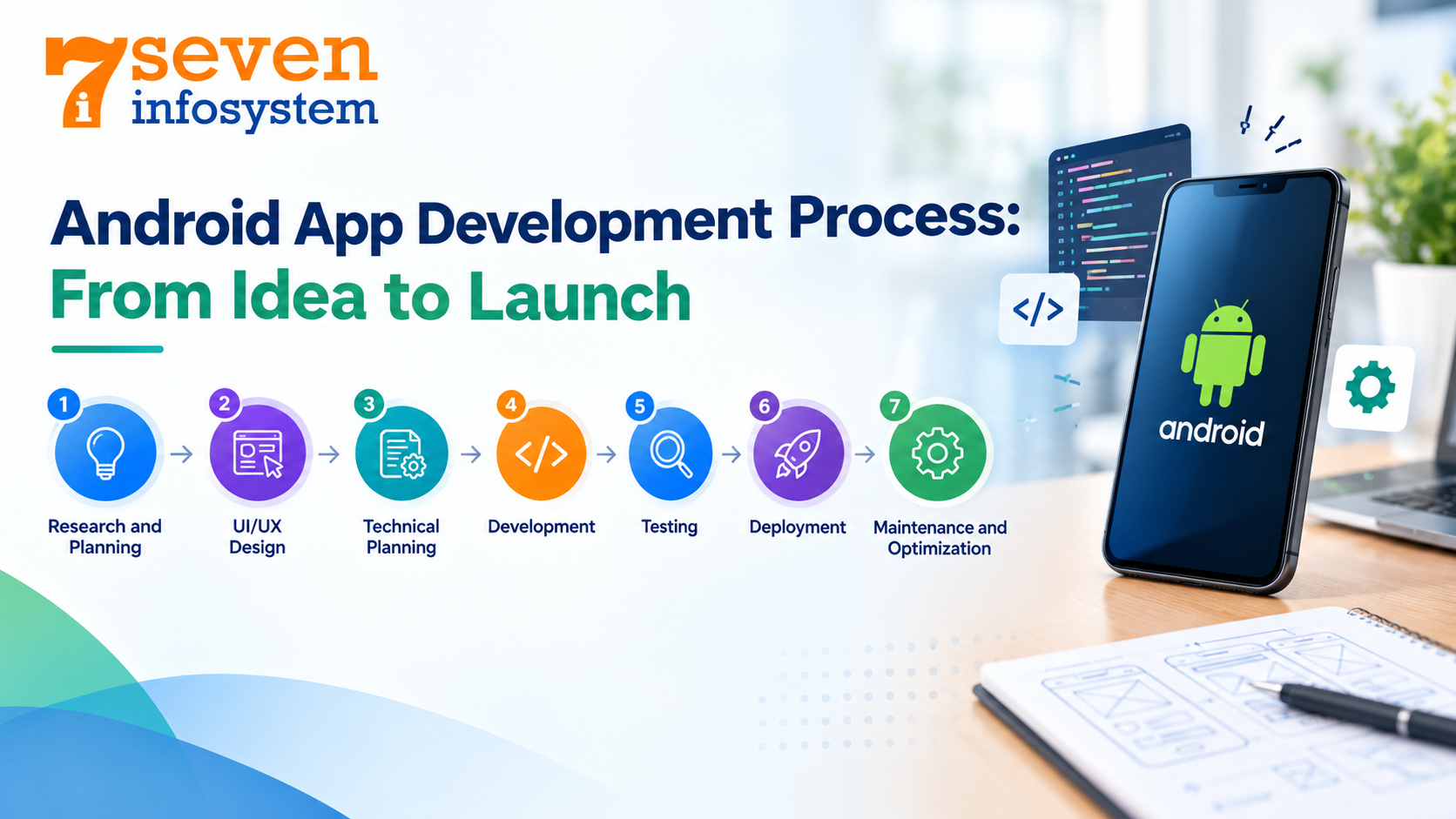
Understanding the Android App Development Process can help businesses get ready for development and make choices during the project.
The process usually includes:
Research and Planning: The team finds out who the users are, what the business goals are, who the competitors are, what the market needs are and what the main features of the app should be.
UI/UX Design: Designers make user flows, wireframes, prototypes and detailed interfaces to decide how users will use the app.
Technical Planning: Developers choose the app structure, the tools to use the connections needed, the database setup, the APIs, the security rules and how the app will grow.
Development: Developers create the app, add back-end services, add features and link any systems that are needed.
Testing: The app is checked for how well it works, how easy it's to use, how fast it runs, how safe it is, how well it works on different devices and how reliable it is.
Deployment: When the app is good enough it is readied for release. Sent to the right Android places.
Maintenance and Optimization: After the app is out developers watch how it performs, fix problems, add updates and make changes based on what users say and what the business needs.
A clear process helps cut down on changes and gives businesses more understanding during the development.
Choosing an Android App Development Partner
The selection of a good development partner could have a lot of effect on the quality, cost, and success of the application.
An Experienced Android App Development Company in India can offer the benefit of accessing specialized developers, UI/UX designers, QA experts, project managers, and technical experts.
In the same manner, an Android App Development Agency in India can help companies looking for end-to-end solutions without creating an entire development team within their company.
While choosing the Best Android App Development Company for a particular project, companies can take into account the following aspects:
- Relevant industry experience
- Portfolio and case studies
- Technical expertise
- UI/UX capabilities
- Security practices
- Testing methodology
- Maintenance and support
- Ability to scale the development team
The right partner should be selected according to the project's requirements rather than based solely on marketing claims or price.
Common Challenges in Android App Development
Managing Development Costs
Advanced technologies like intelligence augmented reality, cloud systems and strong security measures can raise the cost of building applications. Businesses need to focus on features that matter most. These include what users really want, how value they bring to the business, how hard they are to build and what kind of return they are expected to deliver.
Supporting Different Android Devices
Android apps must work across a wide range of devices. Screen sizes vary a lot. Hardware capabilities differ. Operating system versions are not all the same. Device settings and configurations can be different too. Because of this testing the app thoroughly is necessary to make sure every user has an experience.
Maintaining Security and Privacy
Apps that handle sensitive data must have strong security. This means protecting data at every stage. Security should be part of the architecture from the start. It should continue through development, testing, deployment and ongoing updates. Keeping privacy in mind helps protect users and builds trust.
Keeping Up With Technology Changes
The tools and methods for Android development keep changing. New frameworks, libraries and platforms appear regularly. Businesses should not rush to adopt every technology. Instead they should look at whether each new tool fits their goals. A clear technology roadmap based on business needs helps avoid unnecessary changes.
Scaling Android Applications
An app might run smoothly with a few users.. When more people start using it performance and infrastructure can become problems. To prepare for growth businesses should plan for scalability. This includes designing an app architecture that can grow using application programming interfaces relying on cloud services setting up monitoring systems and running regular performance tests.
Conclusion
Android app development is evolving toward smarter, more personalized, connected, secure, and scalable experiences. AI-powered applications, generative AI, machine learning, modern Android development, cloud integration, IoT, augmented reality, voice interaction, and advanced security are among the trends influencing the future of Android applications.
However, businesses should not adopt a technology simply because it is new or popular. The right approach is to identify customer needs, define business objectives, evaluate the practical value of emerging technologies, and choose an Android development strategy that supports long-term growth.
Whether the goal is to improve customer engagement, automate internal processes, create new revenue opportunities, or strengthen a digital presence, staying informed about Android App Development Trends can help businesses make better technology decisions.
Businesses looking for Android App Development Services in India should evaluate potential partners based on their technical capabilities, project experience, development methodology, security practices, and ability to provide ongoing support.
FAQs
1. What are the latest Android App Development Trends?
Major trends include AI-powered applications, generative AI, machine learning, modern Android UI development, cross-platform development, cloud integration, IoT, augmented reality, voice interaction, and stronger application security.
2. How is AI changing Android app development?
AI can help Android applications provide personalized recommendations, intelligent assistance, predictive analytics, automation, fraud detection, content generation, and conversational experiences.
3. Why should businesses invest in Android app development?
Android applications can help businesses reach customers through mobile devices, improve engagement, provide digital services, streamline internal workflows, and create additional revenue opportunities.
4. How much does Android app development cost?
Android App Development Cost depends on factors such as application complexity, features, UI/UX requirements, backend development, integrations, security, testing, and maintenance. A detailed project scope is needed to provide a realistic estimate.
5. What is the Android App Development Process?
The process generally includes research and planning, UI/UX design, technical planning, development, testing, deployment, and ongoing maintenance. The exact workflow can vary depending on the application's requirements.