How to Build a Scalable Enterprise Software Solution
Learn the essential steps to build a scalable enterprise software solution, from architecture and technology selection to security, integrations, testing, and long-term performance optimization.
Introduction
Modern businesses rely on technology to manage daily operations, improve customer experiences, automate repetitive tasks, and make smarter decisions. As companies grow, simple software often struggles to handle complex business needs. That is where an Enterprise Software Solution can make a difference. It helps businesses manage complex processes, large volumes of data, and multiple teams from a unified platform.
Enterprise software goes beyond basic business applications. It needs strong security, high availability, flexible features, and the ability to scale with business growth.
Building a scalable Enterprise Software Solution takes more than choosing a programming language and adding features. Businesses must first understand their goals and requirements. They also need the right architecture, technologies, integrations, and development strategy.
A successful solution should also support legacy system integration, performance testing, security, and future expansion. These factors help businesses maintain reliable software as their needs change.
Whether you are building a large enterprise platform or modernizing an existing application, a clear development strategy can support long-term growth. The right Enterprise Software Solution can improve efficiency, simplify operations, and help your business prepare for future demands.
What Is Enterprise Software?
Before exploring how an Enterprise Software Solution is developed, let’s first understand what enterprise software means. Enterprise software helps organizations manage daily operations, business processes, and data. It supports different departments across the organization.
These departments may include finance, HR, sales, marketing, supply chain, customer support, and operations. An Enterprise Software Solution can support many business functions. Common examples include enterprise resource planning (ERP) systems and customer relationship management (CRM) platforms.
It can also include human resource management systems, inventory management software, and business intelligence tools. Many companies also use custom internal applications for their specific needs.
In case a company has its own workflow, custom enterprise software can offer some functionality that the existing programs cannot offer.
Why Scalability Matters in Enterprise Software Development
Scalability is a key factor when building an Enterprise Software Solution for a growing business. A solution may perform well with a few hundred users. However, performance can change as usage increases.
More employees, customers, transactions, and data can put pressure on the system. Poor architecture can cause slow response times and system downtime. It can also create a poor user experience. These issues can affect productivity and business operations.
A scalable Enterprise Software Solution supports business growth without major system changes. It handles more users, data, and workloads as demand increases.
The right architecture helps maintain performance and reliability. It also reduces the need for costly software rebuilds as the business grows. By planning for scalability from the start, businesses can build an Enterprise Software Solution that supports long-term growth and changing business needs.
Scalability can involve several areas:
- Increasing the number of users an application can support
- Managing larger volumes of data
- Handling more transactions simultaneously
- Adding new business modules
- Integrating additional third-party systems
With a good system in place, companies can grow without always having to upgrade their technology infrastructure.
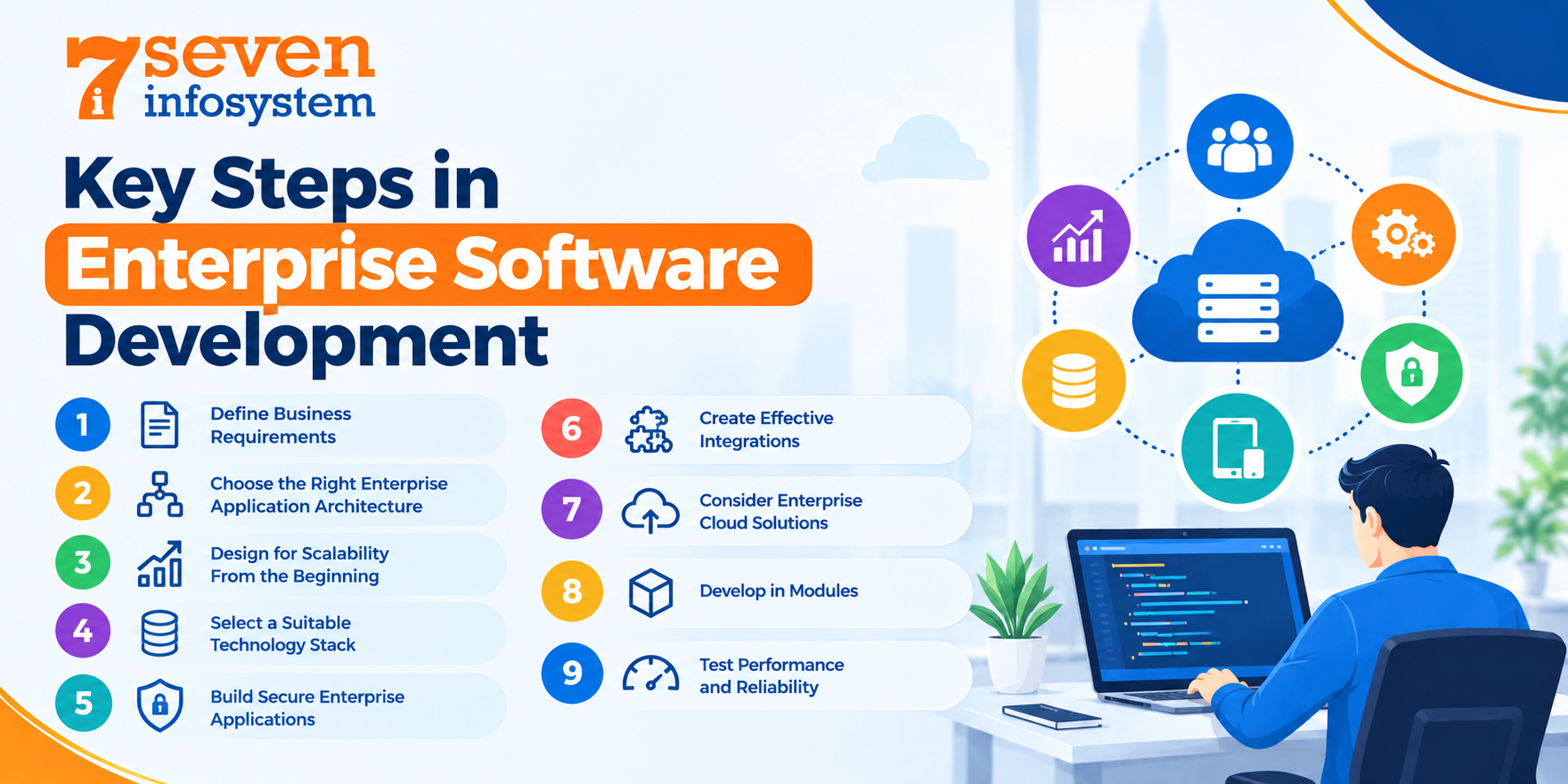
Key Steps in Enterprise Software Development
Creating a solution that can grow needs a plan. Even though each project is different these steps offer a way to do enterprise software development.
1. Define Business Requirements
The first thing is to figure out what the company really needs.
Before choosing tools or making designs the people who make the software should talk to the people in charge to find out about the problems the business has, how things are done now, what users need and what they hope to achieve.
Important questions are:
- What business problem will the software solve?
- Who will use the application?
- Which departments need access?
- What existing systems must be connected?
- What data needs to be stored and processed?
- What security requirements apply?
Requirements analysis will not let the team build useless functionalities but will ensure all necessary functionalities are covered.
This step is particularly important for enterprises that plan to invest in enterprise software development services, since the technology used in the solution must correspond to business goals.
2. Choose the Right Enterprise Application Architecture
The architecture determines how different components of an Enterprise Software Solution communicate, interact, and work together. A well-designed enterprise software architecture can directly impact how easily the solution scales, remains maintainable, and performs reliably over time.
Depending on the project’s requirements, businesses can consider different architectural approaches, including modular, service-oriented, and microservices-based designs.
There is no one-size-fits-all architecture for every Enterprise Software Solution. A small business may benefit from a simpler architecture that is easier to develop and manage, while a large enterprise system with independently scalable components may require a more distributed approach.
When building the architecture developers need to think about:
- Expected application traffic
- Integration requirements
- Maintenance requirements
- Future feature expansion
The goal is to build an architecture that fixes today’s issues and sets up a base for future needs.
3. Design for Scalability From the Beginning
Scalability must be part of the plan from the beginning. It should not be added later as an afterthought.
A scalable application uses methods, like load balancing, caching database tuning, asynchronous processing, horizontal scaling and smart API design.
The database architecture plays a role. If the database is not well structured it can slow things down quickly as data grows.
Developers should look at tasks that need a lot of computing power. They should decide if those tasks can be handled in the background of blocking the main system.
The aim of enterprise software is not just to support many users. It is to keep working even when the business expands, data increases and workloads get heavier.
4. Select a Suitable Technology Stack
Technology choice should be made with consideration of the requirements of the project instead of trends.
The technology stack consists of programming languages, application frameworks, databases, cloud technologies, APIs, development tools, and security solutions.
The following aspects are to be considered while making the decision:
- Application requirements
- Developer expertise
- Integration capabilities
- Community and ecosystem support
- Long-term maintenance
- Infrastructure costs
- Availability of skilled developers
It is also important that the chosen technology stack allows changing it in the future, as enterprise applications work for a long time.
Working with an experienced enterprise software development company can help organizations evaluate these technical considerations before development begins.
5. Build Secure Enterprise Applications
Security should be integrated throughout the development lifecycle rather than added after the application is completed.
Enterprise applications often handle sensitive customer, employee, financial, operational, or business information. A security problem can therefore have serious consequences for an organization.
Security considerations may include:
- Authentication and authorization
- Role-based access control
- Secure database access
- Vulnerability testing
- Secure coding practices
- Regular security updates
Organizations should also decide which users can see information and use certain features. Employees should only get the permissions they need for their jobs.
Security rules should be checked during development, testing, deployment and after the software is in use.
6. Create Effective Integrations
Most companies use different software systems. A new application therefore must be able to talk to existing platforms.
For example an enterprise application might need to share data with accounting software, CRM systems, payment services, inventory tools, HR programs or other outside services.
Designed APIs can help make these connections easier to handle.
Planning for integration should look at data formats, how to log in what to do when errors happen, how to keep things in sync, how fast everything works and how to watch over the system.
This is one reason enterprise application development needs a view, rather than building a single app. The software has to fit into the company's set of technology tools.
7. Consider Enterprise Cloud Solutions
Cloud infrastructure has become a part of modern software development. Enterprise cloud solutions can give organizations infrastructure, scalable resources, managed services, backup capabilities and better accessibility.
Cloud environments can let businesses add or remove resources based on what their applications need. This can be very helpful when there are changes in demand over time.
Putting an application in the cloud does not mean it will be scalable. The application architecture, database design, security configuration, monitoring and deployment strategy still need to be planned.
Organizations should evaluate factors such as:
- Cloud infrastructure requirements
- Disaster recovery
- Cost management
- Performance
- Integration requirements
A thoughtful cloud strategy can provide a strong foundation for enterprise applications.
8. Develop in Modules
Large enterprise applications can become difficult to manage when every feature is tightly connected.
Modular development divides an application into logical components. For example, an enterprise platform might have separate modules for finance, inventory, employee management, reporting, customer management, and administration.
This approach can make it easier to:
- Add new functionality
- Test individual components
- Maintain existing features
- Update specific modules
- Assign development work
- Reduce the impact of changes
Modular design can therefore contribute to long-term maintainability and scalability.
9. Test Performance and Reliability
Functional testing confirms whether an application performs the required tasks. Enterprise applications, however, also need extensive performance and reliability testing.
Testing should examine how the system behaves under different workloads.
Important testing areas can include:
- Load Testing: Load testing evaluates how the application performs with expected numbers of users and transactions.
- Stress Testing: Stress testing examines how the application behaves beyond normal operating conditions.
- Security Testing: Security testing helps identify vulnerabilities and weaknesses that could expose data or functionality.
- Integration Testing: Integration testing confirms that different systems and application components communicate correctly.
- User Acceptance Testing: User acceptance testing allows business users to verify whether the software supports their actual workflows.
Testing throughout development can help identify issues before they affect production users.
Enterprise Application Development Services for Growing Businesses
Businesses often have different technology requirements depending on their size, industry, and internal processes. For this reason, enterprise application development services can cover a wide range of activities, from application design and development to integrations, testing, deployment, and ongoing maintenance.
A development partner may help with:
- Business and technical analysis
- UI and UX design
- Application architecture
- Backend development
- Frontend development
- API development
- Database design
- Cloud deployment
The best way to go depends on what the company wants to achieve. Some businesses might need a brand system while others might just want to make an existing program better.
Custom Enterprise Application Development vs. Off-the-Shelf Software
Pre-made software can be helpful if the basic features match what the business needs.. Some companies have unique processes that don't fit well with standard tools.
Custom enterprise application development lets companies build software that fits their needs.
A custom solution may be appropriate when an organization needs:
- Unique business workflows
- Specialized reporting
- Complex integrations
- Industry-specific functionality
- Greater control over data
- Integration with legacy systems
- A platform that can evolve with the business
The decision should be based on business requirements, cost of ownership implementation time integration needs and long-term goals.
Enterprise Application Modernization
Not every organization needs to replace its existing software. In cases enterprise application modernization can provide a practical alternative.
Legacy applications may continue to perform business functions but become difficult to maintain or integrate with newer technologies.
Modernization can involve:
- Updating outdated technologies
- Refactoring application components
- Migrating workloads to the cloud
- Improving application architecture
- Replacing specific modules
- Introducing modern APIs
- Improving security
- Optimizing databases
The strategy of gradual modernization could enable companies to optimize the existing systems without interrupting daily operations.
The Role of Business Software and Solutions
Technology should ultimately support business outcomes. Business software and solutions are valuable when they help organizations reduce manual work, improve visibility, streamline processes, and make informed decisions.
For example, an enterprise platform can bring information from multiple departments into a central system. Employees can then access relevant information without switching between disconnected applications.
The value of enterprise software is therefore not limited to its technical features. Its effectiveness depends on how well it fits into the organization's operations.
Choosing an Enterprise Software Development Company
Picking a development partner is a step in a software project. Businesses need to judge partners by their technical skill, industry knowledge, how they develop, how they communicate, security strength and after‑launch help.
An experienced enterprise software development company must grasp both the business needs and the technical hurdles.
Organizations can also look at providers who work in development fields. For example a web development company in Rajkot can give web app knowledge while a specialist enterprise tech partner may concentrate on integrations, cloud setup or big business systems.
When businesses look for an ERP software development company in India they should check the company’s experience, with ERP workflows, integrations, data moves, reporting, security and lasting support not the price of development.
Common Challenges in Enterprise Software Development
Enterprise projects can involve significant complexity. Some common challenges include:
- Changing Requirements: Business requirements may change during development. A flexible architecture and clear prioritization process can help teams manage these changes.
- Legacy Systems: Older systems may use outdated technologies or incompatible data structures. Integration and modernization strategies should be planned early.
- Data Migration: Moving information from existing systems can be complicated, especially when databases contain duplicate, incomplete, or inconsistent records.
- Security Requirements: Enterprise applications often require multiple layers of access control and security measures.
- Scalability: Applications need to support increasing workloads without significant performance degradation.
- User Adoption: Even technically strong software may fail to deliver value if employees find it difficult to use. Training, usability, and communication should therefore be part of the implementation strategy.
Best Practices for Building Scalable Enterprise Software
Following a few practical principles can improve the long-term success of an enterprise application.
Start with business goals: Technology should solve clearly identified business problems.
Design for future growth: Consider increasing users, data, transactions, integrations, and functionality from the beginning.
Keep architecture maintainable: Avoid unnecessary complexity and use modular components where appropriate.
Prioritize security: Incorporate security throughout design, development, testing, and deployment.
Plan for maintenance: Enterprise applications require ongoing updates, security improvements, bug fixes, and feature enhancements.
Listen to users: Employee feedback can identify workflow problems that may not be obvious during technical planning.
Conclusion
Building a scalable Enterprise Software Solution is a long-term investment. It requires more than a one-time development project. Successful enterprise software development starts with clear business analysis. It also requires thoughtful architecture and the right technologies. Security, system integrations, testing, and continuous improvement also play key roles. Together, these elements create a reliable and scalable software foundation.
Organizations may build enterprise software from scratch. They may also upgrade existing platforms or adopt cloud technologies. In every case, scalability should remain a core consideration. A well-planned Enterprise Software Solution can support growing user numbers and larger data volumes. It can also handle new integrations and changing business requirements. The right architecture reduces the need for constant redevelopment. A flexible technical foundation also helps businesses adapt as their needs change.
Businesses should focus on clear objectives when developing enterprise software. The solution should address real business challenges and support long-term goals. The most effective enterprise applications do not always offer the most features. Instead, they solve meaningful business problems and integrate smoothly with existing systems. They also maintain strong security and reliable performance. Most importantly, they provide the flexibility businesses need to support future requirements.
FAQs
1. What is enterprise software development?
Enterprise software development is the process of creating secure, scalable applications that help organizations manage complex business processes, data, users, and integrations.
2. How do you build scalable enterprise software?
Scalable enterprise software is built through strong architecture, modular development, optimized databases, cloud infrastructure, security, performance testing, and future-focused planning.
3. What are the benefits of custom enterprise software?
Custom enterprise software is designed around specific business requirements, making it easier to support unique workflows, integrate existing systems, and scale as the organization grows.
4. How much does enterprise software development cost?
The cost depends on factors such as application complexity, features, integrations, technology stack, development time, security requirements, and ongoing maintenance.
5. Why is enterprise application architecture important?
Enterprise application architecture defines how software components interact and scale, helping ensure better performance, security, maintainability, and flexibility as business requirements change.